

Introduction
Over 1.5 million foreign residents now call Portugal home—roughly 14% of the country's population—and Americans represent one of the fastest-growing segments, with 567 residence-by-investment permits issued to North Americans in 2023 alone. The draw is real: year-round sunshine, a cost of living well below most US cities, walkable communities with solid public transit, and an established English-speaking expat network across Lisbon, Porto, the Algarve, and Cascais.
Retiring here involves real complexity, though. The process requires navigating:
- A foreign visa system with strict income thresholds and physical presence requirements
- US tax obligations that don't stop at the border, governed by a bilateral tax treaty
- A housing market where coastal prices have surged considerably
- Healthcare coverage decisions in a system where Medicare doesn't apply
Many Americans underestimate the multi-month processing timelines, AIMA appointment delays, and bureaucratic layering involved in establishing residency.
This guide covers all of it—grounded in 2026 data and regulations.
TLDR:
- Portugal's D7 Passive Income Visa requires €920/month for single applicants and genuine residency (six months presence in year one)
- The Golden Visa no longer accepts real estate investments; qualifying routes now require €500,000 in funds or €250,000 in cultural heritage
- Monthly budgets range from €1,500–€2,400 in Lisbon to €750–€1,200 in smaller Silver Coast towns
- US citizens must still file annual IRS returns regardless of residency; Portugal's NHR tax regime closed to new applicants in 2024
- Medicare does not cover care in Portugal; private health insurance is essential during visa processing and recommended long-term
Why Americans Are Choosing Portugal for Retirement
Portugal ranks 7th globally on the Global Peace Index, making it one of the safest countries in the world. The climate delivers near year-round sunshine along the Atlantic coast, with mild winters and comfortable summers that contrast sharply with US weather extremes. Cities are walkable and well-served by affordable public transit — Lisbon's metro monthly pass runs roughly €40, and intercity rail connects major regions efficiently.
English is widely spoken in Lisbon, Porto, the Algarve, and Cascais, where established expat communities provide social networks and practical transition support.
The appeal is real — but so are the friction points worth understanding before you commit:
- Portuguese bureaucracy is slow and layered—visa processing can stretch multiple months, AIMA (Agency for Integration, Migration and Asylum) appointments face persistent delays, and tax registration requires patience and careful document preparation
- Housing costs in Lisbon and the Algarve have risen sharply; central Lisbon one-bedroom rents now run €1,500–€2,400+, and the Algarve's median property price hit €3,203/m² in Q3 2025—a 16% year-over-year increase
- English fluency drops significantly outside major cities and tourist corridors; daily life in smaller towns requires at least functional Portuguese
Where you settle shapes your experience — and your budget — considerably. Here's how Portugal's main regions compare:
The Algarve
Portugal's southern coast offers 300+ days of sunshine annually, championship golf, and the largest concentration of English-speaking expats. Coastal towns like Lagos, Vilamoura, and Faro deliver beach access and resort amenities. Housing costs are the highest outside Lisbon, driven by sustained international demand.
Lisbon
Portugal's capital has the best healthcare infrastructure, the most extensive public transit, and the strongest job market for working partners. Cultural life is vibrant — museums, restaurants, and nightlife rival any major European capital. Expect to pay a premium across the board.
Porto
Portugal's second city offers meaningfully more affordable housing than Lisbon while maintaining a strong cultural identity, excellent restaurants, and walkable riverside neighborhoods. It draws retirees who want authentic Portuguese character at a lower cost of entry.
The Silver Coast
Stretching north from Lisbon toward Porto, this coastal region — including Nazaré, Peniche, and Óbidos — delivers lower costs and solid real estate value. English is less common here, and amenities are more limited, but the trade-off is a more genuinely local experience.
Visa Options for US Retirees: D7 vs. Golden Visa
The D7 Passive Income Visa
The D7 visa is the primary retirement pathway for Americans with stable passive income sources including Social Security, pensions, 401(k) distributions, IRA withdrawals, dividend income, or rental income. The financial threshold is pegged to Portugal's national minimum wage, which increased to €920/month in 2026.
| Applicant Type | Monthly Minimum | Annual Minimum |
|---|---|---|
| Single applicant | €920 | €11,040 |
| Married couple | €1,380 | €16,560 |
| Couple + 1 child | €1,656 | €19,872 |
Portuguese consular officials often look for a financial buffer above these minimums—plan to demonstrate 20-30% more than the threshold to strengthen your application. Joint bank accounts can satisfy the requirement if you provide a legalized marriage certificate.
Application Requirements:
- Proof of passive income (pension statements, Social Security award letter, investment account documentation showing dividend/interest distributions)
- Proof of accommodation in Portugal (rental agreement or property deed)
- Valid US passport (minimum six months validity)
- FBI or state criminal background check (apostilled)
- Private health insurance covering you in Portugal
- Portuguese Tax Identification Number (NIF)
You must apply at the Portuguese Consulate in the US before moving. After approval, you'll receive a temporary residence permit valid for one year, renewable for two-year periods.
Physical presence requirement: You cannot be absent from Portugal for more than six consecutive months or eight non-consecutive months during the permit validity period. The D7 is designed for retirees who genuinely relocate — consular officials evaluate applications with that expectation in mind.
After five years of legal residency, D7 holders can apply for permanent residency or Portuguese citizenship. A 2024 amendment to the Nationality Law (Lei Orgânica n.º 1/2024) now counts the five-year clock from the date your residence permit application is submitted, not the date of issuance—mitigating processing delays.
The Golden Visa Alternative
The Golden Visa suits retirees with investment capital who need flexibility around physical presence. The stay requirement is minimal: seven days in year one, then 14 days per subsequent two-year period. You can maintain your US residence while building toward Portuguese permanent residency and eventual citizenship eligibility.
Critical 2023 Reform: Real estate purchases no longer qualify for the Golden Visa. The Mais Habitação law (Lei n.º 56/2023) explicitly revoked property investments as an eligible route. Current qualifying investments include:
| Investment Route | Minimum Threshold |
|---|---|
| Investment/venture capital funds (non-real estate) | €500,000 |
| Scientific research | €500,000 |
| Business creation (with 5 permanent jobs) | €500,000 |
| Cultural heritage/artistic production | €250,000 |
All investment funds must be regulated by the Portuguese Securities Market Commission (CMVM). The Golden Visa remains attractive for retirees who cannot meet D7's strict physical presence requirements or who prefer a fund-based investment over demonstrating monthly passive income.
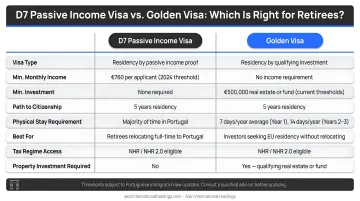
D7 vs. Golden Visa Comparison
| Factor | D7 Passive Income Visa | Golden Visa |
|---|---|---|
| Minimum requirement | €11,040/year passive income (single) | €250,000–€500,000 investment |
| Physical presence | 6 months in first year; max 8 non-consecutive months absence thereafter | 7 days year one; 14 days per subsequent two years |
| Path to permanent residence | 5 years | 5 years |
| Path to citizenship | 5 years (under review; may extend) | 5 years (under review; may extend) |
| Best fit | Retirees genuinely relocating to Portugal | Investors seeking residency optionality with minimal presence |
Essential Setup Steps (Both Visa Routes)
Whichever route you choose, three administrative steps underpin both applications. Start them earlier than you think you need to.
Get your NIF (Número de Identificação Fiscal) — Portugal's tax identification number, required for bank accounts, rental agreements, tax filings, and healthcare registration. Apply through the Portuguese Consulate in the US or appoint a fiscal representative in Portugal. Start this 3-6 months before your move; nearly every subsequent step depends on it.
Open a Portuguese bank account — Required by both D7 and Golden Visa applications. You'll need your NIF and proof of address (your US address works initially). Banks typically request source-of-funds documentation and proof of income under anti-money laundering compliance requirements.
Register with AIMA — After arriving in Portugal, register with AIMA (which replaced the former SEF agency) to receive your residence card. Appointment availability and card issuance can stretch over several months, so factor this into your timeline.
How Much Does It Cost to Retire in Portugal?
Portugal offers lower living costs than most US cities, but housing expenses in popular areas have surged. A realistic monthly budget starts around €1,400–€1,700 in smaller cities and climbs past €3,000 in central Lisbon — before factoring in first-year setup costs.
Monthly Budget Estimates by Region
| Region | Single Retiree (excluding rent) | Typical 1-Bedroom Rent | Total Monthly |
|---|---|---|---|
| Lisbon | €739 (~$820) | €1,500–€2,400 | €2,240–€3,140 |
| Porto | €689 (~$765) | €900–€1,400 | €1,590–€2,090 |
| Algarve (Faro) | €664 (~$735) | €800–€1,250 | €1,465–€1,915 |
| Silver Coast (Aveiro) | €676 (~$750) | €750–€1,000 | €1,425–€1,675 |
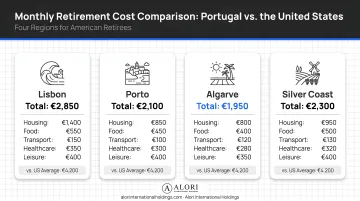
Data from Numbeo (April 2026) and Idealista rental listings. USD equivalents are approximate at a 0.90 EUR/USD rate. Couples should budget roughly 50% more than the primary applicant's figure for the second person.
Housing: Rent vs. Buy
Renting first is widely recommended before committing to a purchase. Rental markets are competitive in Lisbon and the Algarve. Landlords typically request references, proof of income, and payment of first and last month's rent plus a security deposit upfront.
If buying property:
- IMT (Property Transfer Tax): Progressive rates up to 7.5%. Primary residences up to €106,346 are exempt; non-residents buying second homes pay a flat 7.5%.
- Stamp Duty (Imposto do Selo): 0.8% on purchase price, plus 0.6% on mortgage value if financing.
- IMI (Annual Municipal Property Tax): 0.3–0.45% of the property's taxable value (VPT) for urban properties.
Total transaction costs typically run 6–10% of purchase price. Budget for notary fees, registration fees, and legal representation. A Portuguese-speaking lawyer is essential for due diligence on title, permits, and legal structure — title defects and unauthorized builds are more common than buyers expect.
Day-to-Day Living Costs
Portugal delivers meaningful cuts on non-housing expenses:
- Groceries: €200–€300/month for one person
- Dining out: Local restaurant meal €8–€12; mid-range dinner €15–€25
- Public transit: Lisbon metro monthly pass ~€40; Porto similar
- Utilities: €80–€120/month (electricity, water, internet)
- Private health insurance: €60–€150/month depending on age and coverage level
Car ownership is unnecessary in Lisbon and Porto but essential in rural areas. Fuel costs roughly €1.60–€1.80/liter; vehicle registration and annual road tax add €100–€300/year depending on engine size.
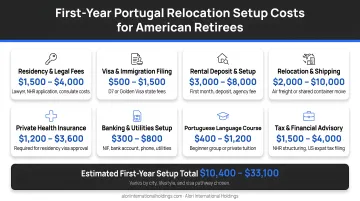
First-Year Setup Costs
Don't overlook one-time expenses that catch unprepared retirees off guard:
- D7 visa application fee: ~€83
- NIF and bank account setup: €50–€200 if using professional services
- Flights and initial accommodation: €1,000–€3,000
- Housing deposit (first/last month + security): €2,000–€5,000 in Lisbon
- Legal and professional services (fiscal representative, lawyer, translator): €500–€2,000
- Furniture and household setup if buying: €3,000–€10,000
Budget €5,000–€15,000 in first-year setup costs beyond your normal monthly expenses.
US Taxes and Financial Planning for American Retirees
US Filing Obligations Continue
US citizens must file annual federal tax returns (Form 1040) with the IRS regardless of where they live or how long they've been abroad. Living in Portugal does not eliminate US tax filing obligations. Many retirees mistakenly believe foreign residency exempts them from IRS reporting — it does not.
How the US-Portugal Tax Treaty Treats Different Income Streams
The 1994 US-Portugal Income Tax Treaty provides mechanisms to avoid double taxation, but the treatment varies by income type:
Social Security: Generally taxable only in the US under the treaty, though Portugal retains the right to tax benefits paid to Portuguese residents. In practice, most retirees report Social Security only to the IRS.
Private pensions (401(k), IRA, private employer pensions): Generally taxable in Portugal as your country of residence. You'll report this income to Portuguese tax authorities and use Foreign Tax Credits (Form 1116) to offset Portuguese taxes paid against US liability.
US government-service pensions (federal employees, military): Typically taxable only in the US.
Investment income (dividends, capital gains, rental income): Generally taxable in both countries, depending on source and structure. Dividends from US stocks typically face US withholding tax plus Portuguese income tax; treaty provisions allow credits to reduce the overlap.
Critical recommendation: Confirm how your specific income mix is treated before moving. Work with a cross-border tax advisor familiar with both US and Portuguese tax law. Errors in this area are costly and difficult to unwind after the fact.
The End of NHR and the Post-2024 Tax Reality
Portugal's Non-Habitual Resident (NHR) tax regime offered a flat 10% rate on foreign pension income and was a major draw for American retirees. It closed to new applicants as of January 1, 2024.
The replacement program (IFICI) strictly targets scientific researchers, academics, and highly skilled professionals in innovation sectors. Standard retirees do not qualify.
What this means: If NHR was part of your retirement tax plan, that strategy no longer works. You'll be subject to Portugal's standard progressive income tax rates (ranging from 13.25% to 48% depending on income level), without the favorable treatment foreign pension income previously enjoyed.
Ongoing US Reporting Requirements
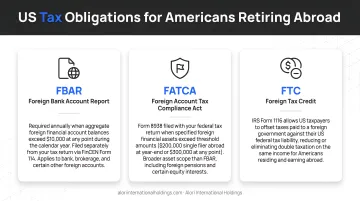
Three federal reporting obligations continue regardless of where you retire:
- FBAR (FinCEN Form 114): Required when foreign account balances exceed $10,000 in aggregate at any point during the year. Penalties reach $10,000 per violation for non-willful failures — higher for willful non-compliance.
- FATCA (Form 8938): Required when specified foreign financial assets exceed $200,000 at year-end (or $300,000 at any point) for single filers abroad. Thresholds double for married couples filing jointly.
- Foreign Tax Credit (Form 1116): Used to offset Portuguese taxes paid against US tax liability, preventing double taxation on the same income.
The Tax Residency Trap
Many retirees confuse visa and residence permit status with tax residency — these are separate legal categories. The distinction matters more than most people realize:
- Visa status determines your right to live in Portugal
- Tax residency determines which country can tax your worldwide income
- Under Article 16 of the Portuguese IRS Code, maintaining a "habitual home" in Portugal can trigger tax residency even if you spend fewer than 183 days there
Establishing Portuguese tax residency earlier than expected is a common and expensive surprise, creating an obligation to declare worldwide income to Portugal. Map out your specific tax position under both systems before you move — not after your first year of residency has already closed.
Healthcare in Portugal for US Retirees
The SNS Public Health System
All legal residents are entitled to access Portugal's public health system (Serviço Nacional de Saúde, or SNS) once they've established residency. To register, visit your local health center (Centro de Saúde) with your NIF, proof of address, and residence card. Portugal eliminated most user fees (taxa moderadora) in June 2022, so routine consultations, specialist referrals, and hospitalizations are generally free for registered residents. Dental and cosmetic care are not covered.
Why Many Retirees Still Choose Private Insurance
Despite free SNS access, many American retirees maintain private health insurance. The reasons are practical:
- Wait times are significant — the Health Regulatory Entity (ERS) reported in 2024 that 51.6% of first specialty consultations exceeded maximum guaranteed response times, with 776,000+ patients on waiting lists
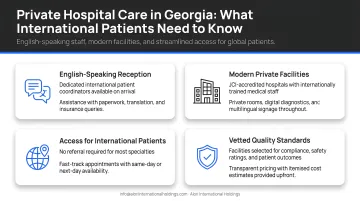
- Private facilities like Hospital CUF and Hospital da Luz employ more English-speaking staff and are set up for international patients
- Private coverage offers faster diagnostics, a wider choice of providers, and shorter procedure wait times
Sample private consultation costs (without insurance):
- Hospital CUF Lisbon: Medical specialty €104–€125; surgical specialty €96–€125
- Hospital da Luz Lisbon: First consultation €70–€225; urgent care €100–€145
Monthly private insurance premiums for retirees aged 60-70 typically range €60–€150 depending on coverage level.
Medicare Does Not Work in Portugal
Medicare does not cover care received outside the United States. Retirees who split time between Portugal and the US may want to maintain Medicare Parts A and B for coverage during US visits, but Medicare cannot replace private or SNS coverage while you're in Portugal. Many retirees assume Medicare travels with them — it doesn't, so arranging separate coverage before you arrive is essential.
Private health insurance is mandatory during the visa application phase, covering the gap before SNS registration kicks in. Many retirees choose to keep it long-term to avoid wait times and retain full provider choice.
Buying Property in Portugal: What US Retirees Should Know
Why Property Ownership Can Make Sense
Portugal places no restrictions on foreign ownership—Americans can buy property on the same terms as Portuguese citizens. For long-term retirees, ownership offers stability (no risk of rent increases or landlords selling), potential capital appreciation in markets like Lisbon, Porto, and the Algarve where values have risen steadily, and the ability to customize your living space.
But rent first. Most advisors recommend renting for 6-12 months to understand the market, confirm your preferred region, and avoid costly mistakes. Foreign buyers consistently overpay—in Greater Lisbon, transactions by foreign tax residents averaged 61.7% higher per square meter than domestic buyers in Q3 2025.
Transaction Costs US Buyers Often Underestimate
Beyond the purchase price, budget for:
- IMT (property transfer tax): Progressive rates scaling with purchase price, up to 7.5% for non-primary residences
- Stamp duty: 0.8% on purchase price, plus 0.6% on mortgage if financing
- Notary and registration fees: €500–€1,500
- Annual IMI (municipal property tax): 0.3-0.45% of taxable property value
Total transaction costs typically run 6-10% of purchase price. Budget separately for legal representation as well. A Portuguese-speaking lawyer conducting due diligence on title, permits, building compliance, and ownership structure isn't optional—it's the primary defense against the legal complications that catch foreign buyers off guard.
Working with Firms That Reduce Transaction Risk
Buying from the US compounds these challenges—assessing fair market value remotely, verifying developer credibility, understanding rental licensing, and managing legal due diligence across time zones requires local infrastructure most buyers don't have.
Alori International Holdings specializes in curated Portugal property opportunities for American buyers. The firm provides access to vetted properties and off-market deals sourced through local networks, with in-market professionals managing title verification, legal compliance, and regulatory navigation. For buyers who don't want to learn the Portuguese legal system the hard way, that in-country coordination is what makes the difference.
Frequently Asked Questions
How much money do you need to retire in Portugal from the USA?
The D7 visa requires approximately €920/month passive income for a single applicant (€11,040/year). Realistically, budget €1,425–€1,675/month total in smaller Silver Coast towns or €2,240–€3,140/month in Lisbon. Couples should add roughly 50% more for the second person.
Does Portugal tax US retirement income?
It depends on the income type: Social Security is generally taxed only in the US, private pensions (401(k), IRA) are typically taxable in Portugal, government pensions are usually US-only, and investment income may face taxation in both countries. Advance planning with a cross-border tax advisor is essential before you move.
Can I still collect my Social Security if I move to Portugal?
Yes. The Social Security Administration pays benefits to retirees living in Portugal, and payments can be deposited directly into a Portuguese bank account. Social Security income may still be taxable in the US depending on your overall income level.
What is the 5 year rule in Portugal?
After five years of legal residency under either the D7 or Golden Visa, holders can apply for permanent residency or Portuguese citizenship. A 2024 law change now counts this five-year clock from the date your residence permit application is submitted, not the date of issuance. Note that Portugal's nationality law is currently under review and the timeline may change.
Is it hard for an American to retire in Portugal?
The D7 visa is accessible for most retirees who meet the €920/month passive income threshold, but the process is slow in practice. Multi-month processing times, AIMA appointment delays, and Portuguese bureaucracy require patience and careful document preparation. Budget 6–12 months for the full visa and residency setup.
Is Portugal still a good place for Americans to retire?
Yes, though the picture has shifted. Lifestyle, climate, safety, and cost advantages outside major cities remain strong. That said, housing costs in Lisbon and the Algarve have risen sharply, the NHR tax regime no longer applies to new arrivals, and bureaucratic processing times are slower than most Americans expect. Go in with realistic financial planning and patience for the administrative process.