

The challenge? Knowing which approach delivers genuinely passive income versus which quietly morphs into a second job. Many investors launch into real estate assuming all rental properties are passive, only to find themselves fielding 2 a.m. maintenance calls and chasing down late rent payments.
This guide breaks down the top passive income strategies with real estate—what sets each apart, the true passivity level of each, and how to match the right approach to your capital base, risk tolerance, and income goals.
Key Takeaways
- Real estate combines cash flow, appreciation, and tax advantages simultaneously — no other common asset class delivers all three at once
- Top strategies include long-term rentals, REITs, short-term vacation rentals, international properties, and syndications — capital needs and effort vary widely across each
- True hands-off income requires professional management, vetted advisory firms, or REIT structures
- International markets like Portugal and Georgia offer strong yields with diversification benefits unavailable in domestic markets
- The right strategy depends on your capital, how involved you want to be, and whether you're optimizing for yield, growth, or geographic diversification
Why Real Estate Stands Out as a Passive Income Vehicle
Real estate delivers a unique three-part advantage for passive income: monthly cash flow from rent, long-term property appreciation, and built-in inflation protection as rents typically rise with inflation. Few other asset classes combine all three benefits simultaneously.
Tax Benefits That Multiply Returns
The tax advantages of real estate push effective yields well above the headline rental income number. The IRS allows residential rental property depreciation over 27.5 years, creating paper losses that offset rental income without actual cash expenditures.
Investors can also defer capital gains through 1031 exchanges when selling one property and reinvesting in another — though this applies exclusively to real property held for business or investment.
Real estate professional status requires 750+ hours of material participation annually, which allows passive losses to offset non-passive income—a significant advantage for full-time investors.
Real Estate vs. Other Passive Income Vehicles
Over a 10-year horizon, here's how real estate compares to other major asset classes:
- U.S. Large Cap Equities (S&P 500): 13.11% - 14.18% annualized
- Public Real Estate (REITs): 5.77% annualized
- Private Real Estate (NCREIF): 4.90% annualized
- U.S. Bonds: 2.20% annualized
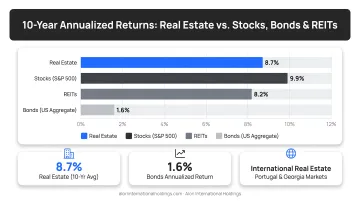
Real estate's tangible nature and inflation-tracking income explain why family offices allocate 18% to 22.5% of portfolios directly to real estate, using it as a core wealth preservation asset.
True Passivity Requires the Right Structure
Not all real estate investing demands active involvement — that assumption keeps many investors on the sidelines. True passive exposure is achievable through several well-established structures:
- Professional property management — typically 8–10% of collected rent handles day-to-day operations
- REITs — publicly traded funds providing liquid, hands-off real estate exposure
- Syndications — pooled private deals where a sponsor manages the asset
- Curated investment platforms — vetted international opportunities with defined entry, income, and exit structures
The right structure depends on how much capital you're deploying, your tax situation, and whether you want domestic or cross-border diversification.
Top Passive Income Strategies with Real Estate
These five strategies vary in passivity, capital requirements, and return profiles. Selecting the right one depends on your goals, not just the headline yield.
Long-Term Residential Rentals
Long-term rentals—single-family or multi-unit properties rented on 12+ month leases—represent the most familiar real estate strategy. When managed by a professional property management company, this becomes largely passive.
Key Advantages:
- Predictable monthly cash flow
- Tenant-backed mortgage reduction
- Long-term appreciation potential
- Professional management fees of 8-12% handle tenant relations and maintenance
Critical Considerations:
Market selection matters more than the property itself. 54.8% of U.S. counties saw rental yield declines in 2026 as record-high home prices compressed returns. The national rental vacancy rate stands at 7.2%, meaning investors should budget for periodic vacancy periods.
Top Rental Yield Counties in 2026:
- Saint Clair County, IL: 14.5%
- Mobile County, AL: 13.6%
- Peoria County, IL: 12.5%
Midwest markets consistently deliver higher yields than coastal markets, where Suffolk County, NY yields 10.8% while Santa Clara County, CA yields just 3.1%.
Short-Term / Vacation Rentals
Short-term rentals via Airbnb and VRBO can generate higher revenue than long-term rentals in tourist destinations, major metros, or unique properties. But this comes with a significant passivity trade-off.
Passivity Reality Check:
Self-managing a short-term rental requires 10-15 hours per week, handling turnover cleaning, guest communication, and dynamic pricing. Professional STR management costs 15-25% of monthly rental income—nearly double the cost of long-term rental management.
Regulatory Risks:
Global cities are aggressively restricting short-term rentals:
- New York City: Local Law 18 reduced active listings from 38,000 to 3,000 after September 2023 enforcement
- Barcelona: Will not renew 10,000 tourist flat licenses when they expire in 2028, eliminating STRs entirely
- France: Requires national registration by May 2026 with proof of primary residence
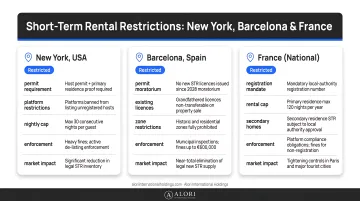
Research local ordinances before investing. Unless fully outsourced, short-term rentals are the least passive strategy on this list.
Real Estate Investment Trusts (REITs)
For investors who want real estate income without owning property, REITs offer a direct path. They pool capital to own income-generating properties—apartments, office buildings, retail centers, healthcare facilities. By law, REITs must distribute at least 90% of taxable income to shareholders, making them high-yield passive income instruments.
Current Yields:
As of December 2025, the FTSE Nareit All Equity REITs Index yielded 4.07%, while the broader All REITs Index yielded 4.44%.
Key Trade-offs:
REITs offer liquidity and low entry costs—accessible via any stock brokerage account—but sacrifice control over property selection. They're sensitive to interest rate movements, though research shows weak long-term correlation (-0.25 mean) between Treasury returns and REIT returns.
Public vs. Private REITs:
- Public REITs: Daily liquidity, SEC transparency, lower fees
- Private REITs: Limited liquidity (7-10 year holds), higher upfront fees (15-18%), but shielded from daily market volatility
International Real Estate Investment
International real estate offers both yield and diversification for investors seeking returns uncorrelated with U.S. domestic cycles. Markets like Portugal and Georgia stand out for their entry prices, rental demand, and legal frameworks that explicitly support foreign ownership.
Portugal:
National average gross rental yield: 4.33%, with Lisbon averaging 3.82% and Porto 4.02%. Secondary municipalities offer higher yields—Seixal yields 6.6% and Moita yields 6.5%.
Critical Update: Real estate is no longer an eligible route for Portugal's Golden Visa following 2023 reforms. Current pathways require €500k in investment funds or scientific research.
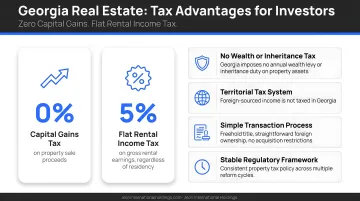
Georgia (the country):
National average gross rental yield: 7.42%, with Tbilisi averaging 7.53% and Batumi 7.31%—among the highest in Europe. Foreign nationals have unrestricted purchase rights except for agricultural land.
Tax Advantages:
- 0% annual property tax on non-income-generating properties
- 0% capital gains tax if held 2+ years
- 5% flat income tax on rental earnings
Navigating Complexity:
Most investors avoid international real estate due to legal complexity and remote management concerns. The difference between a frustrating experience and a passive one usually comes down to who guides the process. Alori International Holdings focuses specifically on Portugal and Georgia, providing vetted properties with verified legal structures, defined exit strategies, and in-country professionals who handle what remote owners can't. That infrastructure is what makes cross-border investment workable at a distance.
Real Estate Syndications and Crowdfunding
Syndications pool capital to purchase large commercial or multifamily assets that professional operators manage. Investors receive quarterly distributions from rental income plus appreciation shares upon sale.
Crowdfunding platforms like Fundrise and CrowdStreet have opened this model to smaller investors, with entry minimums ranging from $500 (crowdfunding) to $50,000+ (private syndications).
Once capital is deployed, there are no management responsibilities. All operations are handled by the syndicator.
Limitations:
- Illiquid capital (typically locked 3-7 years)
- Returns depend heavily on operator execution
- Requires thorough due diligence on both the deal and the syndicator
- Limited redemption options before project sale
Syndications suit investors who want commercial real estate exposure without the capital requirements or operational overhead of direct ownership.
How to Choose the Right Real Estate Passive Income Strategy
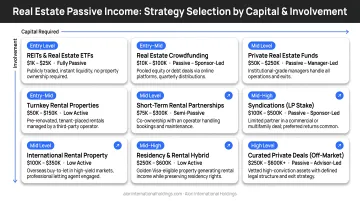
Selection hinges on four investor variables: available capital, desired passivity level, time horizon, and risk tolerance.
Quick Mapping:
- $10k–$50k + High Passivity: REITs or crowdfunding platforms
- $50k–$150k + Medium Passivity: REIT portfolios or syndications
- $150k–$600k + Low-Medium Passivity: Direct property ownership with professional management or international real estate
- $600k+ + Any Passivity: Any strategy or combination
Common Mistake: Chasing Yield Without Counting Hours
A short-term rental yielding 12% annually still requires 20+ hours per month without professional management. At 15–25% management fees, the net yield drops significantly. Calculate true returns after accounting for time or management costs.
Market Selection Drives Long-Term Returns
Market selection matters more than property selection. Research shows 1,000 new jobs increase nearby rents by 0.5–1% and sale prices by at least 2%, confirming that employment growth directly drives real estate returns. A strong property in a weak market will underperform a mediocre property in a high-growth one over any five-year horizon.
Focus on markets with:
- Strong job growth and population expansion
- Infrastructure investment (transit, digital connectivity)
- Favorable regulatory environments
- Tourism or corporate demand drivers
Plan Your Exit Before You Enter
Once you've identified your market, exit planning is the next decision — not an afterthought. Investors who skip this step often find themselves holding underperforming assets with no clear path out. Build your exit into the investment thesis from day one.
Key exit planning checkpoints:
- Confirm legal ownership structure before purchase (LLC, trust, foreign entity)
- Understand local capital gains tax and repatriation rules
- Set a target hold period (3, 5, or 10 years) and review triggers
- Verify resale liquidity in your target market before committing
Conclusion
Real estate remains one of the most proven paths to passive income, but the approach must match the investor. REITs offer liquidity and low barriers to entry. International markets like Portugal and Georgia offer stronger yield potential and geographic diversification. The right strategy is the one that fits your capital, timeline, and tolerance for complexity.
What separates genuinely passive income from a second job is execution infrastructure. Local market knowledge, legal diligence, and professional management handle the details that would otherwise consume your time.
For investors looking to access international real estate as a passive income strategy, Alori International Holdings focuses on curated opportunities in Portugal and Georgia — markets selected for structural demand, verified legal frameworks, and clear rental income potential. Reach the team directly at info@aloriinternationalholdings.com to explore current opportunities.
Frequently Asked Questions
How can I make $1,000 a month in passive income?
The most direct paths are owning a professionally managed rental property, building a REIT portfolio with sufficient capital, or combining multiple streams like REITs and crowdfunding. The exact capital needed depends on your target market's yield, your use of leverage, and management costs.
What is the best property investment for passive income?
The right choice depends on your capital, timeline, and how hands-on you want to be. Long-term rentals deliver stable cash flow; REITs offer liquidity and low entry barriers; international markets like Portugal and Georgia add diversification and often stronger yields. Match the strategy to your situation, not the other way around.
What are the highest-paying passive income opportunities in real estate?
Short-term vacation rentals and commercial real estate typically generate the highest gross yields but require more management or higher capital. International markets in emerging economies can deliver strong yields (7-12%+) with lower acquisition costs than comparable U.S. assets, particularly when professionally managed.
Is international real estate a good passive income strategy?
Yes—markets with strong rental demand, favorable foreign ownership laws, and growing tourism or expat populations can outperform domestic options. The key is partnering with people who have genuine in-country expertise to handle legal compliance and ongoing remote management.
Do I need to actively manage a property to earn passive income from real estate?
Active management isn't necessary. Property managers handle tenants, maintenance, and rent collection for around 8–10% of collected rent. REITs, syndications, and curated investment platforms go further—they handle everything, with no landlord responsibilities at all.
What is the difference between a REIT and direct property ownership for passive income?
REITs offer liquidity, low minimum investment, and instant diversification—but you have no say in which assets are held. Direct ownership gives you control, leverage, and potentially higher returns, though it requires more capital and is harder to exit quickly.