
Introduction
For American retirees feeling the squeeze of rising costs, Georgia — the country nestled between the Caucasus Mountains and the Black Sea — offers a concrete alternative. Retirement income stretches 50–70% further than in the US, paired with a European lifestyle, ancient wine culture, and mountain scenery that few expat destinations can match. Georgia remains genuinely undiscovered compared to more crowded markets, which means lower costs, fewer bureaucratic hurdles, and real estate that hasn't yet been bid up by international demand.
This guide provides a practical roadmap for American retirees and expats considering Georgia. We'll cover residency pathways, tax advantages, cost of living, healthcare realities, and real estate opportunities — giving you the information you need to evaluate whether Georgia fits your retirement plan.
Key Facts at a Glance:
- US citizens enter visa-free and can stay up to 365 days without documentation
- Foreign pension income is taxed at 0% under Georgia's territorial tax system
- Couples live comfortably on $1,500–$2,000/month in Tbilisi or Batumi
- A $150,000+ property purchase unlocks a 3-year renewable residency permit
- Georgia ranks among Europe's safest countries, with violent crime rates well below US averages
Why Retire in Georgia: The Expat Case
The Tax Advantage That Changes Everything
Georgia operates a territorial tax system, meaning it only taxes income earned within its borders. For retirees, this translates to 0% Georgian tax on US Social Security, foreign pensions, dividends from overseas investments, and rental income from properties outside Georgia. This applies whether you're a tax resident or not.
The contrast with other destinations is stark:
| Location | Tax Rate on Pension/Retirement Income |
|---|---|
| Georgia | 0% (on foreign-sourced income) |
| United States | 10–22% federal + state taxes |
| Spain | 18–45% (progressive rate) |
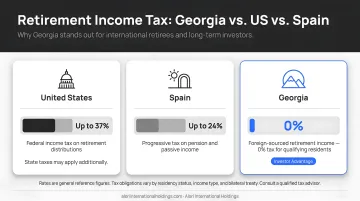
One important caveat: US citizens remain subject to IRS worldwide taxation regardless of where they live. Georgia eliminates local tax liability; it doesn't eliminate your US filing obligation.
Safety You Can Measure
Safety ranks as a top concern for retirees choosing an overseas base. Georgia delivers measurable results: the country consistently ranks in the top 20 safest nations globally on the Global Peace Index, with violent crime rates roughly one-fifth of US averages. Petty theft exists in tourist areas, but violent crime against foreigners remains exceptionally rare.
A Lifestyle Worth the Move
Georgia blends European café culture with Caucasus mountain traditions. You'll find:
- Ancient wine country: Georgia invented winemaking 8,000 years ago; vineyard tours and traditional qvevri wines define the culture
- Diverse geography: Black Sea beaches in Batumi, alpine hiking in Kazbegi, fertile valleys in Kakheti
- Vibrant expat communities: growing international populations in Tbilisi and Batumi provide built-in social networks
- European feel, frontier pricing: cobblestone old towns, outdoor cafés, and walkable neighborhoods at a fraction of Western European costs
The Language Reality
Georgian uses a unique alphabet and language structure unrelated to any other. However, younger Georgians in Tbilisi and Batumi widely speak English, particularly in commercial districts, restaurants, and service businesses. Functional English is common among urban residents under 40 — roughly 40–50% in the major cities — but drops sharply outside Tbilisi and Batumi and among older generations.
Most retirees manage daily life in Tbilisi entirely in English. A few dozen Georgian phrases — greetings, numbers, basic requests — go a long way toward building rapport with locals.
The Healthcare Trade-Off
Georgia's healthcare infrastructure lags behind Western Europe, especially outside Tbilisi and Batumi. The country is not EU-affiliated, and rural medical facilities offer limited services. However, private hospitals in Tbilisi — such as Aversi Clinic and New Hospitals — meet solid international standards for routine care, diagnostics, and most surgical procedures. Retirees with serious chronic conditions or complex medical needs should weigh this limitation carefully.
Residency Options for Retirees in Georgia
Visa-Free Entry: The Easiest Starting Point
US citizens can enter Georgia and stay **up to 365 consecutive days without a visa**. This resets upon exit and re-entry, making it practical as a long-term evaluation period while you decide whether to commit. For retirees weighing property investment or permanent relocation, spending a full year first is a low-risk way to validate the decision.
Property Investment Residence Permit
Purchase residential property worth at least $150,000 USD, and you qualify for a 3-year renewable residence permit. Key details:
- Renewable means you can extend the permit indefinitely as long as you maintain property ownership
- You can complete purchases remotely via power of attorney through a licensed Georgian lawyer
- This pathway counts toward permanent residency requirements after 6 years of continuous legal residence
- The $150,000 threshold is based on certified appraisal value, not just purchase contract price
For most retirees, this is the most practical pathway: it builds legal status while the property itself functions as a real asset with potential rental upside.
Investor Visa (5-Year, Family-Inclusive)
A $300,000 investment qualifies for a 5-year residence permit that extends to your spouse and dependent children. It's worth considering if you're moving with family, have a longer planning horizon, or are building business interests in Georgia alongside your retirement plans.
Path to Permanent Residency and Citizenship
After 6 years of continuous legal residence under any category, you qualify for permanent residency. Citizenship requires 10 years plus passing tests in Georgian language, history, and law.
Important caveat: Georgia generally does not permit dual citizenship. Americans pursuing Georgian citizenship would need to renounce US citizenship — a step with serious tax and legal consequences that warrants independent legal counsel before proceeding.
Mandatory Health Insurance (Starting January 1, 2026)
All foreign visitors staying more than 30 days must carry health insurance with minimum coverage of 30,000 GEL (approximately $11,000 USD). International expat plans typically satisfy this requirement and cost $40–120/month depending on age and coverage level.
Georgia's Tax Advantages for Foreign Retirees
How the Territorial Tax System Works
Georgia taxes only income sourced within Georgia. For retirees, that means foreign income faces 0% Georgian tax across the board:
- US Social Security payments
- Foreign pensions
- Dividends from overseas investments
- Rental income from foreign properties
This applies whether you hold Georgian tax residency or not — and the distinction matters less than most people expect.
The 183-Day Residency Threshold
Spending fewer than 183 days per year in Georgia keeps you as a non-resident (0% on all foreign income). Exceeding 183 days creates Georgian tax residency, but foreign-sourced income remains 0% taxed. Only income earned locally (such as Georgian rental income or local business profits) faces the flat 20% rate.
The US-Specific Caveat
Georgia's 0% treatment does not eliminate US tax obligations. The IRS taxes American citizens on worldwide income regardless of where they live. Before making any decisions, US retirees should:
- Review the US-Georgia tax treaty for applicable credits and exclusions
- Understand foreign earned income exclusion (FEIE) eligibility
- Consult a US expat tax professional familiar with Georgian residency rules
How Georgia Compares to Other Expat Tax Havens
| Country | Foreign Pension Tax Treatment |
|---|---|
| Georgia | 0% (permanent, territorial system) |
| Portugal | 0% for 10 years via NHR, then standard rates apply |
| Greece | 7% flat tax for 15 years |
| Spain | Progressive 18–45% |
Unlike Portugal's NHR or Greece's flat-rate programs, Georgia's territorial system isn't a time-limited incentive — it's simply how the country taxes income. That structural permanence is a meaningful factor for retirees planning a decade or more abroad.
Cost of Living and Healthcare in Georgia
Monthly Budget Breakdown
Single Retiree in Tbilisi:
- Rent (1-bedroom, central): $400–600
- Rent (1-bedroom, suburb): $250–400
- Groceries: $200–300
- Utilities (electric, water, internet): $60–100
- Transportation (public transit/taxis): $30–50
- Health insurance: $50–100
- Dining out & entertainment: $150–250
- Total: $1,140–1,800/month
Couple in Tbilisi:
- Rent (2-bedroom, central): $600–900
- Groceries: $350–500
- Utilities: $80–120
- Transportation: $50–80
- Health insurance (two people): $100–200
- Dining out & entertainment: $250–400
- Total: $1,530–2,200/month
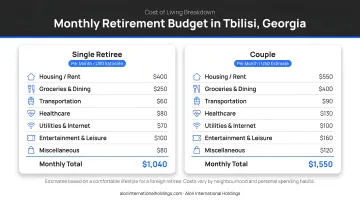
The common "$1,000 a month rule" assumes roughly $240,000 saved per $1,000/month of retirement income at a 5% withdrawal rate. Georgia fits that math well. A single retiree can live comfortably on $1,200–1,500/month; couples typically need $1,500–2,000/month for a good quality of life.
Healthcare: Dual Structure
Georgia's Universal Healthcare Program (UHCP) covers emergency services and primary consultations for residents, but expats typically rely on private health insurance for comprehensive care.
Private Insurance Costs:
- Basic local plan: $500–1,000/year
- International expat plan: $1,200–3,000/year
Sample Procedure Costs (Out-of-Pocket):
- CT scan: $80–150
- Dental filling: $30–60
- Hospital stay (private room, per day): $100–200
Out-of-pocket care in Georgia costs a fraction of US prices — often 70–80% less — even without insurance coverage.
How Georgia Compares Globally
Those low healthcare costs reflect a broader pattern. According to Numbeo's 2024 Cost of Living Index, Georgia's overall affordability stands out even among other popular expat destinations:
- 30–40% cheaper than Portugal
- 40–50% cheaper than Spain
- Roughly on par with Thailand for overall living costs
This affordability is structural — driven by Georgia's wage base and cost environment — not a short-term dip.
Where Georgia Costs More
Housing in **central Tbilisi** has risen as expat demand has grown; expect to pay $600–900 for a modern 2-bedroom apartment in Vake or Saburtalo. Imported goods (electronics, Western brands, certain foods) cost 20-30% more than in the US due to shipping and tariffs.
Best Cities and Regions for Retirees in Georgia
Tbilisi: The Urban Expat Hub
Tbilisi is the default choice for most expats and retirees. As Georgia's capital and largest city, it offers:
- Best private hospitals and international clinics
- Strongest English-language services
- International airport with direct flights to Europe and the Middle East
- Growing food scene, cultural events, and expat community
Popular neighborhoods for foreigners:
- Vake: upscale residential area, tree-lined streets, cafés, parks; rent $600–900 for 2-bedroom
- Saburtalo: central location, university district, good public transport; rent $500–750 for 2-bedroom
Batumi: The Black Sea Alternative
Batumi offers a completely different lifestyle:
- Milder winters and beach access
- Lower rents than central Tbilisi ($400–650 for 2-bedroom)
- Growing expat community
- Subtropical climate
For retirees who prioritize outdoor living and proximity to the sea over urban convenience, Batumi is a strong fit. Healthcare facilities are adequate but more limited than Tbilisi — worth factoring in for anyone with ongoing medical needs.
Beyond the Cities: Kutaisi and Mountain Towns
Outside the two main cities, options diverge sharply on cost versus amenities:
- Kutaisi (Georgia's second city): rents run $300–500/month for a 2-bedroom, but less English is spoken and expat services are sparse
- Highland towns (Kazbegi, Mestia): dramatic mountain scenery and peaceful lifestyles, but healthcare access is very limited — better suited as seasonal retreats than full-time bases for anyone with regular medical needs
Buying Property in Georgia as a Retirement Investment
How Foreign Property Ownership Works
Foreigners can freely purchase residential and commercial property in Georgia with no restrictions. Key details:
- Agricultural land requires a local LLC structure (not available for direct foreign ownership)
- Transactions can be completed remotely via power of attorney through a Georgian lawyer
- No annual property tax on owner-occupied residential property
- Digital property registry enables ownership registration within 24 hours
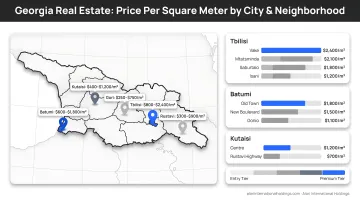
Current price ranges (per square meter):
- Central Tbilisi (Vake, Vera): $1,500–2,500
- Suburban Tbilisi: $800–1,400
- Batumi city center: $1,200–2,000
- Batumi suburbs: $700–1,200
Property as a Dual-Purpose Asset
Beyond securing a 3-year residency permit, Georgian real estate in growing urban neighborhoods has demonstrated capital appreciation potential. Tbilisi property prices have increased approximately 5-8% annually over the past five years, with rental yields ranging from 5-10% depending on location and property type.
Those two return drivers — appreciation and income — work together in Batumi's short-term rental market, where tourist-focused properties can yield 8-12% annually during peak seasons, though this requires active management.
Navigating the Market with Professional Guidance
For American investors entering a foreign market for the first time, the risks are tangible: overpaying on mispriced listings, unclear title history, weak exit options, and the difficulty of coordinating transactions remotely.
Alori International Holdings works with retirees navigating exactly this situation. The firm vets legal structures, verifies pricing against market data, and builds defined exit strategies into each opportunity — focusing on a selective set of neighborhoods in Tbilisi and Batumi rather than broad market exposure. The goal is to give investors a clear view of what they're buying and why, before they commit.
Essential Due Diligence Steps
- Title verification through the National Agency of Public Registry
- Legal support from a licensed Georgian lawyer for contract review and registration
- Developer track record verification for off-plan purchases
- Appraisal confirmation to ensure property meets the $150,000 residency threshold
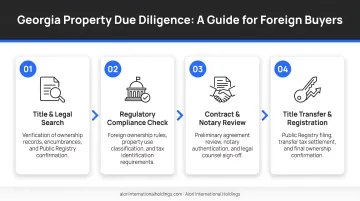
Georgia's registry system moves quickly — but a single unverified title or mispriced appraisal can derail both your investment and your residency application.
Frequently Asked Questions
What is the $1000 a month rule for retirement?
The rule states that for every $1,000/month of retirement income needed, you should have $240,000 saved (based on a 5% withdrawal rate). In Georgia, $1,000/month per person covers a modest retirement, while $1,200–$1,500/month adds room for dining out and occasional travel.
Where is the best place to live in Georgia for retirees?
Tbilisi offers the best urban amenities and healthcare access. Batumi provides a coastal lifestyle with milder winters. Choose Tbilisi if medical infrastructure and city services are the priority; choose Batumi for beach living and lower day-to-day costs.
Is Georgia a good country for expats?
Yes. Georgia is among the most expat-friendly countries in the region — visa-free access, a territorial tax system, low living costs, and a strong safety record make it a straightforward choice. The main practical hurdle is the language barrier, though English is widely spoken in Tbilisi and Batumi.
Do US citizens need a visa to retire in Georgia?
No. US citizens enter visa-free and can stay up to 365 days without any paperwork. Long-term residency requires either a property purchase ($150,000+) or an investment pathway ($300,000+) — Georgia has no traditional retirement visa.
Is foreign pension income taxed in Georgia?
No. Under Georgia's territorial tax system, foreign pensions (including US Social Security) face 0% Georgian tax for both residents and non-residents. However, US citizens remain subject to IRS worldwide taxation regardless of where they live.
Can foreigners buy property in Georgia?
Yes. Foreigners freely purchase residential and commercial property. A $150,000+ purchase qualifies for a 3-year renewable residency permit. Transactions can be completed remotely through a Georgian lawyer holding power of attorney.