

Introduction
American investors face a difficult dilemma: domestic real estate markets have become competitive, overpriced, and correlated with the broader economy. Many who seek diversification find that accessing foreign real estate feels opaque and risky. Without local expertise, transparent legal structures, or trusted partners, international property investment often appears more like speculation than strategy.
Boutique real estate investment firms solve this problem through selectivity, local expertise, and disciplined strategy. Unlike large institutional funds forced to deploy capital across dozens of markets, boutique firms focus on a curated selection of high-conviction opportunities where they possess genuine depth. Understanding what sets these firms apart — and what to look for in a partner — is the first step toward investing internationally with confidence.
TLDR:
- Boutique real estate firms prioritize depth over breadth, targeting fewer markets with rigorous analysis
- Smaller capital pools allow boutique firms to access deals institutional investors must skip
- High-conviction markets combine structural demand, regulatory stability, and durable fundamentals
- Partnering with local experts lowers legal risk and unlocks off-market opportunities unavailable to outside investors
- Investors in the $100K–$600K range gain curated deal access, vetted legal structures, and direct communication unavailable through institutional channels
What Is a Boutique Real Estate Investment Firm?
A boutique real estate investment firm is a smaller, independent investment company that focuses on a curated selection of markets or asset types rather than pursuing volume-driven deal flow. The term "boutique" signals intentionality—fewer bets, made with greater conviction and depth. These firms reject the mass-market approach, prioritizing quality over quantity in every investment decision.
Structurally, boutique firms differ from large institutional players in a meaningful way. Large funds face mandates that force them into specific deal sizes and markets to deploy capital efficiently. A $500M fund cannot acquire dozens of mid-range properties without excessive operational complexity, so it gravitates toward larger, high-visibility assets.
Boutique firms operate without these constraints. That freedom lets them pursue differentiated opportunities that large players structurally cannot access — including off-market deals, emerging submarkets, and asset types too small to move the needle for institutional capital.
Defining Characteristics of High-Quality Boutique Firms
Two characteristics distinguish professional boutique real estate firms:
Specialized Market Knowledge: Rather than spreading attention across twenty markets, boutique firms concentrate on two or three regions where they maintain in-country professionals, developer relationships, and regulatory fluency. That depth produces more accurate underwriting, stronger vendor networks, and consistent access to off-market inventory.
Client-Aligned Investment Philosophy: Boutique firms are not pressured to deploy capital on quarterly timelines or satisfy institutional volume targets. That independence lets them wait for the right entry point, walk away from weak deals, and structure investments around long-term capital preservation rather than short-term metrics.
Narrow focus and deep execution are what separate boutique firms from the rest of the investment landscape. Among REITs, private equity funds, and other vehicles competing for the same capital, boutique firms stand apart through independence and genuine selectivity.
The Boutique Advantage: Why Selectivity Beats Scale in Real Estate Investing
Boutique firms possess a core structural advantage: because they manage smaller pools of capital, they can target deals that institutional investors must overlook. Large funds have large acquisition mandates—they cannot efficiently deploy $500M by buying mid-range properties scattered across secondary markets. This creates a permanent gap in the market where boutique firms operate with less competition and better entry points.
Price Competition and Valuation Dynamics
When fewer buyers compete for a property, the acquirer can enter at better valuations. Institutional capital drives up prices on high-visibility assets in gateway cities—trophy buildings in Lisbon, prime beachfront in the Algarve—because multiple large funds chase the same limited inventory. Boutique firms operating in less contested deal flow environments can find better entry points and preserve upside that would otherwise be competed away.
Depth Over Breadth
A boutique firm covering two or three markets will outcompete a generalist firm covering twenty, because depth of local knowledge translates directly into competitive advantage. That edge requires more than spreadsheet modeling from a distant headquarters. It means understanding:
- Municipal regulations and permitting timelines
- Rental licensing requirements and local compliance rules
- Local taxation structures affecting net returns
- Micro-location demand patterns that aggregate data misses
This kind of on-the-ground knowledge isn't replicable at scale — it's built through sustained presence in a specific market.
Investment Discipline Without Institutional Pressure
Large fund managers may feel pressure to deploy capital even when conditions are unfavorable. Limited partners expect their capital to be put to work, and fund economics depend on deployment timelines. Boutique managers can wait for the right entry point without that same pressure. The ability to pass on a deal when pricing is stretched — rather than deploy on schedule — is a structural advantage most institutional managers simply don't have.
A 2021 SEC advisory report on private investments found that focused portfolios can deliver competitive or superior returns compared to broadly diversified institutional real estate funds — particularly when managers possess genuine expertise in their target markets.
How Boutique Firms Identify High-Conviction Markets
A high-conviction market is not just about current growth—it's about structural, durable demand drivers that will sustain value across cycles. Boutique firms analyze demographic trends, capital flow patterns, regulatory stability, and real asset supply constraints to distinguish momentum from fundamentals.
The Layered Research Framework
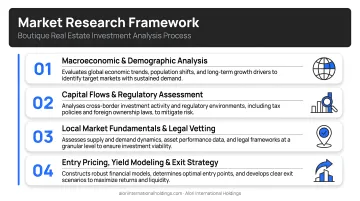
Professional boutique international real estate firms use a multi-layered research framework:
- Macroeconomic indicators — currency stability, GDP trajectory, inflation trends, and interest rate environments that determine whether property values hold across cycles
- Demographic trends — urbanization, migration patterns, and workforce composition that signal whether housing demand is structural or temporary
- Regulatory frameworks — foreign ownership rules, property rights protections, tax treatment, and residency pathways that determine execution risk
- On-the-ground intelligence — local professionals with transaction experience, cultural knowledge, and access to off-market deal flow that no desktop research can replicate
Portugal and Georgia as High-Conviction Markets
Portugal exemplifies a high-conviction European lifestyle market. The country attracts sustained tourism demand, with tourism exports reaching €4.3 billion in monthly revenue. Rising expat communities, favorable tax frameworks for foreign investors, and undersupplied housing relative to tourism and migration inflows create durable demand.
Portugal offers transparent property ownership frameworks through the Conservatória do Registo Predial, providing full legal title protection to foreign buyers.
Georgia represents a high-conviction frontier market. The country offers 0% VAT on property purchases, 0% annual property tax, and 5% flat income tax on rental earnings. Foreign ownership is unrestricted, and property registration occurs within 24 hours through Georgia's digital registry system. $100K+ property investments qualify investors for permanent residency, creating a residency-by-investment pathway alongside financial returns.
Alori International Holdings has established expertise in both markets, combining data-driven market analysis with in-country professionals to bridge global capital with local intelligence.
Why Local Execution Matters
Local partners are what convert a correctly identified market into a successful investment. They reduce legal risk, ensure accurate pricing, and open access to off-market opportunities that are invisible to foreign buyers transacting at arm's length.
Market-specific execution risks underscore this point:
- Portugal: Active property management is required to mitigate adverse possession risks — unoccupied properties can revert to squatters under local law
- Georgia: Rigorous title due diligence is essential to clear legacy registration issues and avoid agricultural land ownership prohibitions
Exit Strategy Clarity
A high-conviction market is one where the firm has clarity on how and when capital can be returned—whether through rental yield, resale to a growing pool of buyers, or currency appreciation. Investors should look for boutique firms that underwrite entry and exit simultaneously, ensuring that every investment has a documented path to liquidity.
Boutique vs. Large Real Estate Investment Firms: A Direct Comparison
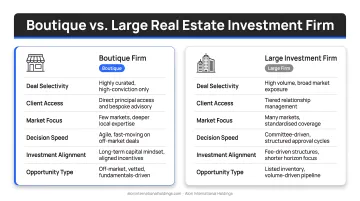
Large firms and boutique firms serve different investor needs. The right choice depends on capital size, goals, and how much weight you place on scale versus conviction.
Where Large Firms Have Advantages
Large institutional real estate firms bring scale, brand recognition, and the reach to acquire trophy assets in major markets. Their advantages include:
- Portfolio breadth: Diversified holdings across geographies, asset classes, and economic cycles reduce concentration risk
- Operational infrastructure: In-house legal, HR, and accounting functions lower transaction overhead
- Competitive positioning: Established reputations help them win bids in high-demand markets
For institutional investors deploying tens of millions of dollars, these advantages are meaningful.
Where Boutique Firms Have Advantages
For individual investors in the $100K–$600K range, boutique firms offer distinct benefits:
- Direct access to decision-makers: Communication is transparent and tailored — investors work with the people actually managing capital, not relationship managers.
- Hand-selected deals: Rather than sorting through hundreds of listings, investors receive opportunities vetted for fundamentals, legal compliance, and long-term value.
- No pressure to deploy: Boutique firms can pass on unfavorable deals — there's no institutional mandate to put capital to work on a fixed timeline.
- Right-sized deal flow: Boutique firms pursue opportunities scaled for individual capital — deals that institutional funds are too large to pursue efficiently.
The core tradeoff comes down to this: large firms offer breadth; boutique firms offer depth. For investors who want a curated, high-conviction approach rather than broad market exposure, the boutique model is designed around that preference.
Key Risks in Boutique Real Estate Investing and How Good Firms Manage Them
Boutique investing carries legitimate risks that investors should understand before committing capital.
Boutique-Specific Risks
Key-man risk is real in smaller operations. Over-reliance on a handful of individuals creates continuity problems if those people leave. Professional boutique firms address this through documented processes, team redundancies, and succession planning — not just institutional knowledge in one person's head.
Limited deal flow sounds like a weakness. In practice, selectivity is the strategy: fewer deals, higher conviction. The risk only materializes if a firm compromises quality to fill a pipeline. Ask how they say no, not just how they say yes.
Undercapitalization is worth probing directly. Smaller firms may lack the reserves to support distressed assets or weather a market downturn. Ask how the firm is capitalized and what happens to investor positions if conditions deteriorate.
International Investment Risks
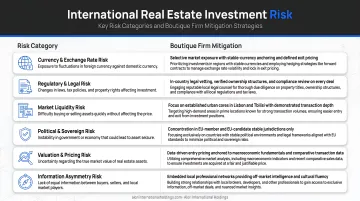
Cross-border real estate introduces risks that domestic investing simply doesn't carry:
- Currency fluctuation affecting returns in USD terms
- Foreign ownership regulations that vary significantly by country
- Unclear title structures or disputed property rights
- Limited legal recourse when disputes arise abroad
On top of these, US investors buying through foreign entities face strict IRS reporting requirements — including FATCA Form 8938 and PFIC classifications — that can trigger punitive tax consequences if structures aren't transparent upfront.
Boutique firms with genuine local presence and vetted legal infrastructure are built to reduce these risks. Firms without that infrastructure pass the risk directly to investors.
How Transparency and Structure Reduce Risk
Investors should look for firms that provide:
- Verified legal structures with clear documentation of ownership rights
- Defined exit strategies underwritten at deal entry
- Honest communication about risks, not just upside
- Access to in-country professionals who manage execution
These aren't nice-to-haves. They're the baseline for knowing what you own, how you'll exit, and who's accountable when problems arise.
What to Look for in a Boutique Real Estate Investment Partner
Genuine Local Expertise
A real boutique international real estate firm will have in-country professionals who understand local regulations, transaction norms, cultural nuances, and off-market deal flow—not just a website claiming international focus. When evaluating a partner, dig into the specifics:
- Where the firm's professionals are actually based
- How long the firm has operated in each market
- What developer relationships they maintain and how those were built
Investment Philosophy Alignment
The best boutique partners prioritize long-term capital preservation and structural demand over short-cycle speculation. If a firm's pitch emphasizes aggressive returns or momentum-driven positioning, proceed cautiously. Disciplined firms talk about realistic expectations, risk-adjusted performance, and how they protect capital on the downside — not just how fast they can grow it. Ask directly how they select markets, how long they hold assets, and what their definition of success actually looks like for investors.
Transparent Operations and Clear Communication
Professional boutique firms provide clear explanations of deal structure, legal protections, fee arrangements, and exit strategies. They communicate honestly about risks and market conditions, avoiding promotional language or speculative claims. Investors should expect regular communication, documented processes, and direct access to decision-makers.
Alori International Holdings operates this way by design. The firm combines data-driven market analysis with in-market professionals across Portugal and Georgia, focusing on curated opportunities with defined entry points, verified legal structures, and clear exit strategies for investors in the $150K–$600K range.
Frequently Asked Questions
What is a boutique real estate investment firm?
A boutique real estate investment firm is a smaller, independent investment company focused on a curated set of markets or asset types. It offers investors specialized knowledge, disciplined deal selection, and personalized service rather than high-volume, generalized deal flow.
What are the 4 types of investment companies?
The four main types are open-end funds (including mutual funds), closed-end funds, exchange-traded funds (ETFs), and unit investment trusts. Boutique real estate firms typically operate outside these structures as private equity vehicles or advisory firms—giving investors access to curated deal flow and return profiles not available through public markets.
How is a boutique real estate firm different from a large investment firm?
Boutique firms prioritize depth over breadth, targeting fewer markets with more rigorous analysis. Large firms pursue scale and diversification. For individual investors, boutique firms often offer more curated opportunities and direct communication.
What markets do boutique international real estate firms focus on?
Boutique international firms target markets where structural demand, stable regulatory environments, and sound fundamentals support long-term capital growth. Common examples include Southern European markets like Portugal and emerging Eastern European cities like Tbilisi, Georgia.
Can American investors buy property abroad through a boutique real estate firm?
Yes. Boutique international real estate firms help American investors access vetted foreign property opportunities by managing legal complexity, local market intelligence, and transaction structuring.
What should I look for when choosing a boutique real estate investment firm?
Prioritize verified local expertise in target markets, a transparent investment philosophy, and clear communication around deal structure, legal protections, and exit strategies. Ask pointed questions about in-country presence and how the firm manages downside risk.