

A well-structured real estate portfolio is the difference between scattered purchases and strategic wealth accumulation. This guide covers the steps to build your portfolio, diversification tactics across property types and geographies, key financial metrics to track, and proven growth strategies that let you scale responsibly.
TLDR:
- Start by defining clear investment goals and assessing your financial position before acquiring properties
- Diversify across property types (residential, commercial, REITs) and geographies to reduce single-market risk
- Track critical metrics: cap rate, cash-on-cash return, DSCR, and the 50% rule to evaluate deals accurately
- Use strategies like BRRRR, house hacking, and REITs to accelerate portfolio growth while managing risk
- International diversification in markets like Portugal and Georgia offers lower entry costs and reduced correlation with domestic cycles
What Is a Real Estate Portfolio?
A real estate portfolio is a collection of property assets — rental homes, commercial spaces, REITs, vacation rentals, land, or some combination — held with the deliberate goal of building income and long-term wealth. Unlike owning a single property, a portfolio is designed so that holdings work together to meet financial objectives across different market conditions.
Three Main Portfolio Types:
- Residential: Single-family homes, duplexes, multifamily buildings (2-4 units or larger apartment complexes)
- Commercial: Office buildings, retail centers, industrial warehouses, self-storage facilities
- Hybrid: Mixed asset classes including passive instruments like REITs, crowdfunding platforms, or international properties
The key distinction is between active management—where you directly oversee properties, tenants, and maintenance—and passive investing, where you rely on professional managers, REIT operators, or syndication sponsors to handle day-to-day operations.
What separates a real estate portfolio from a random collection of properties is intentional structure. Strong portfolios balance cash flow generators with appreciation plays, stable markets with emerging ones, and residential with commercial exposure — built to hold up across different economic cycles.
How to Build a Real Estate Portfolio: Step-by-Step
Step 1: Define Your Investment Goals and Risk Tolerance
Starting with clear goals is non-negotiable. Are you targeting monthly cash flow, long-term appreciation, tax benefits, or geographic diversification? Your goals shape every downstream decision: property type, location, financing structure, and timeline.
Common Goal Frameworks:
- Cash Flow Focus: Prioritize properties generating positive monthly income (multifamily units, short-term rentals in high-demand areas)
- Appreciation Focus: Target emerging markets with strong job growth and infrastructure development
- Tax Strategy: Leverage depreciation deductions, 1031 exchanges, and cost segregation studies
- Lifestyle + Income: Purchase properties in desirable locations for personal use and rental income
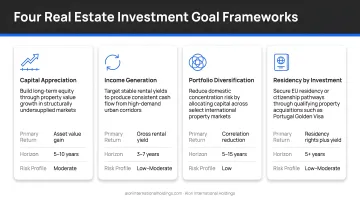
Risk tolerance determines your strategy. Conservative investors favor stable single-family rentals in established neighborhoods with predictable cash flow. Higher-risk appetites may lean toward emerging markets, value-add commercial properties requiring renovation, or international opportunities with stronger growth potential but different regulatory environments.
Step 2: Assess Your Financial Position
Before acquiring any property, audit your financial position honestly:
- Credit Score: Most lenders require 620+ for investment properties; 740+ unlocks best rates
- Down Payment Capital: Conventional investment loans require 15-25% down according to Freddie Mac and Fannie Mae guidelines (85% LTV for 1-unit, 75% LTV for 2-4 units)
- Existing Debt Load: Calculate your debt-to-income ratio; Fannie Mae's standard maximum DTI is 36%, though it can extend to 45% with strong credit
- Emergency Reserves: Fannie Mae requires six months of liquid reserves for investment property transactions
Get pre-approved for financing before searching. Understand your borrowing capacity and how much you can deploy while maintaining sufficient reserves for vacancies, repairs, and market downturns.
Step 3: Choose Your Starting Point
You don't need $200,000 to start. Low-barrier entry strategies include:
- House Hacking: Purchase a duplex or triplex, live in one unit, rent the others to offset or eliminate your mortgage
- Small Multifamily: Buy a 2-4 unit property with owner-occupant financing (lower down payment requirements)
- REITs: Purchase shares of publicly traded Real Estate Investment Trusts for market exposure without direct ownership (minimum investment: price of one share)
Starting small allows you to learn property management, tenant screening, cash flow analysis, and renovation budgeting before scaling to larger assets.
Step 4: Research Your Target Markets
That scaling process only works if you're entering the right markets. Evaluate each target location across these factors:
- Rental Demand: Population growth, job market strength, major employers, university presence
- Vacancy Rates: Lower vacancy indicates strong demand; U.S. rental vacancy averaged 7.2% in Q4 2025
- Property Value Trajectory: Historical appreciation trends, new construction pipeline, infrastructure projects
- Local Regulations: Rent control laws, landlord-tenant legislation, short-term rental restrictions
Look beyond primary cities. Secondary and tertiary markets often offer better entry prices and higher return potential. According to Cushman & Wakefield (Q3 2025), the U.S. multifamily vacancy rate stood at 9.0%, with oversupply in Sunbelt markets pushing rent growth to just 0.6% YOY—signalling the importance of selective market research.
International markets also merit consideration for investors seeking lower entry costs and portfolio diversification. However, access to local expertise and in-country professionals is critical—regulatory frameworks, transaction processes, and cultural nuances vary significantly between jurisdictions.
Step 5: Acquire and Finance Strategically
Common Financing Paths:
- Conventional Loans: 15-25% down, fixed rates, 15-30 year terms for long-term rentals
- Portfolio Loans: Held by individual lenders (not sold to Fannie/Freddie), often used when holding multiple properties
- Hard Money Loans: Short-term, high-interest financing for fix-and-flip or bridge scenarios
- DSCR Loans: Qualification based on property cash flow rather than personal income; most lenders require 1.20x-1.25x DSCR minimum
Use leverage wisely. Debt amplifies both returns and risk. A property that cash flows well at 75% LTV may struggle at 85% LTV once vacancy or maintenance costs arise.
Step 6: Monitor, Manage, and Scale
Building a portfolio is iterative. Track these metrics consistently across every asset:
- Occupancy rates — prolonged vacancies signal a pricing or management problem
- Net operating income monthly, not just gross rent
- Local market values annually to identify refinancing or exit opportunities
- Cash flow after all expenses and debt service, per property
Reinvest profits into acquiring additional assets. Scaling responsibly means ensuring each existing asset performs well before adding new ones. A single underperforming property can constrain your financing capacity for the next acquisition — so performance reviews aren't optional, they're structural.
How to Diversify Your Real Estate Portfolio
Portfolio diversification in real estate means spreading exposure across property types, investment strategies, and geographies to reduce the impact of any single market downturn on overall returns.
Diversification by Property Type
Each asset class behaves differently during economic cycles:
- Single-Family Homes: Stability, easier financing, lower operational complexity
- Multifamily Units: Stronger cash flow, economies of scale in management, lower per-unit vacancy impact
- Commercial Properties: Longer lease terms (3-10 years), higher income potential, more sensitive to economic cycles
- REITs: High liquidity, professional management, required to distribute 90% of taxable income as dividends per IRS Code § 857, providing steady income without direct ownership burdens
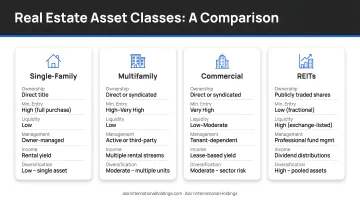
Mix these asset types to balance stability with growth and liquidity with control.
Geographic Diversification
Owning properties in only one city or country concentrates risk. Research using panel data from 62 U.S. metro areas demonstrates that house price dynamics vary significantly based on local factors like city size, income growth, and construction costs.
Coastal cities with high construction costs (Boston, New York, San Francisco) exhibit stronger price momentum and are more prone to overshooting fundamental values compared to inland markets.
Why Geographic Spread Matters:
- Protects against localized economic shocks (factory closures, natural disasters, regulatory changes)
- Captures growth in multiple regions simultaneously
- Reduces correlation risk—domestic markets can move together during national recessions
International Real Estate as Strategic Diversification
For investors already holding domestic assets, international real estate offers a concrete hedge against home-market volatility and currency concentration risk. Markets like Portugal and Georgia have attracted sustained investor interest because of:
- Favourable Entry Prices: Lower cost basis compared to established Western markets
- Structural Demand Drivers: Tourism growth, infrastructure development, rising expat communities
- Investor-Friendly Regulatory Environments: Transparent ownership frameworks, unrestricted foreign ownership
For investors seeking access to these opportunities with vetted legal structures and defined exit strategies, firms like Alori International Holdings specialize in curating high-conviction international real estate opportunities backed by local expertise and data-driven market analysis.
Key Due Diligence for International Diversification:
- Review GDP growth, employment trends, and inflation rates before committing capital
- Track cross-border investment activity and migration patterns as leading demand signals
- Verify foreign ownership rights, title registration systems, and local property tax structures
- Assess exchange rate volatility and whether rental income is denominated in local or foreign currency
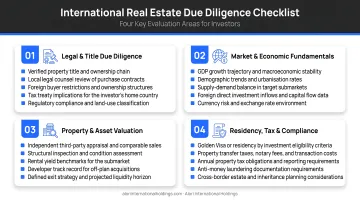
Having in-market professionals reduces transaction and legal risk considerably. Local experts navigate municipal regulations, verify developer track records, and identify micro-locations with genuine rental demand.
Key Financial Metrics Every Real Estate Investor Should Know
Cap Rate (Capitalization Rate)
Formula: Net Operating Income ÷ Property Value
Cap rate assesses a property's income potential independent of financing. For example, a property generating $30,000 in annual NOI and valued at $500,000 has a 6% cap rate.
"Good" cap rates vary by market and property type. According to CBRE's U.S. Cap Rate Survey, cap rates have stabilized across major property types, with spreads between asset classes narrowing as pricing adjusts to the higher interest rate environment.