

This guide walks you through exactly how Georgia's investment residency and citizenship pathway works, what it costs in 2026, and what to realistically expect if you're considering this as part of a long-term international diversification strategy.
TLDR:
- Georgia requires residency first; citizenship eligibility opens after 10 years of legal residence
- Property investment threshold increased to $150,000 as of March 2026 (up 50% from $100,000)
- Dual citizenship is prohibited—Americans must renounce their U.S. passport to naturalize
- Georgia offers flat 20% income tax, 15% corporate tax, 137 visa-free destinations, and significantly lower cost of living than the U.S.
Why Investors Are Looking at Georgia in 2026
Georgia sits at the crossroads of Europe and Asia, a geographic position that translates into tangible economic advantages beyond lifestyle appeal. The country maintains active free trade agreements with the European Union (Deep and Comprehensive FTA since 2016), China (FTA since 2018), Turkey (FTA since 2008), and CIS member states, creating tariff-free export corridors for businesses operating in-country.
The macro picture backs this up:
- The Heritage Foundation's 2026 Index of Economic Freedom scores Georgia at 69.6, ranking it 35th globally and 20th in Europe as "Moderately Free"
- Numbeo's 2026 Safety Index ranks Georgia 21st globally with a Safety Index of 73.8 and Crime Index of 26.2
- Tourism continues to drive structural demand—Georgia recorded 5.8 million international visitors in 2025, up 7% year-over-year, generating approximately $1.74 billion in travel income
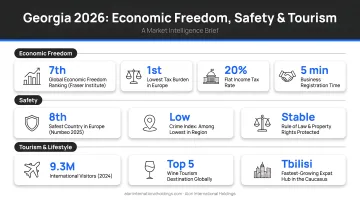
Investor interest here is driven by structural demand, not speculative momentum. Property prices sit well below Western European equivalents, rental yields in Tbilisi and Batumi run 5–10% annually, and Georgia's territorial tax system exempts foreign-source income from taxation entirely.
For American investors seeking portfolio diversification outside the U.S., Georgia offers a disciplined entry point into a frontier market with improving fundamentals. This is a long-term capital story, not a passport play.
Georgia's Investment Routes to Residency (and the Path to Citizenship)
Georgia offers two distinct investor visa tiers. Neither delivers citizenship directly. Both lead to permanent residency first, then citizenship by naturalization after 10 years total.
Tier 1: The $150,000 Property Route
As of March 1, 2026, investors must hold Georgian real estate valued at $150,000 or more—a 50% increase from the previous $100,000 threshold in place since 2019. This investment grants a 1-year renewable temporary residence permit.
Key details:
- The $150,000 threshold applies to total property holdings, not a single purchase
- Investors can combine multiple registered properties to meet the minimum
- Valuation is based on accredited appraisal, not purchase price. Appraisals must be conducted by bodies accredited by Georgia's National Accreditation Body (GAC)
- Agricultural land is strictly excluded from qualifying assets
Timeline to citizenship:
After 5 years on the temporary permit, investors become eligible for permanent residency. After a further 5 years (10 total), they may apply for citizenship by naturalization.
One practical risk on this route: selecting a property that passes purchase but fails the accredited appraisal. Alori International Holdings focuses specifically on Georgian properties with verified legal structures and clear valuation histories, which helps investors avoid that outcome.
For investors who want a faster path to permanent residency and can commit more capital upfront, Tier 2 offers a more direct route.
Tier 2: The $300,000 Investor Visa
Investors who contribute $300,000 or more to Georgian real estate or a business receive an immediate 5-year residence permit covering spouse and minor children. This permit converts to permanent residency after the 5-year term. After 10 years of permanent residency, investors become eligible for citizenship.
Business investment option:
If the $300,000 goes into a business, the enterprise must meet minimum annual turnover thresholds:
- Year 1: Approximately $50,000 equivalent in GEL
- Year 2: $100,000
- Years 3–5: $120,000 annually
These thresholds ensure the business operates as a going concern, not a passive holding vehicle.
Eligibility Requirements for the Investment Route
Core eligibility criteria:
- Meet the investment threshold ($150,000 or $300,000)
- Prove legal origin of funds — AML compliance is strictly enforced through bank statements, tax returns, and auditor opinions
- Clean criminal record (no international crimes, serious offenses, Interpol listings, or threats to Georgian national security)
- Eventual proficiency in Georgian language, history, and law (required at the citizenship stage, not residency)
Dual citizenship restriction — critical for Americans:
Georgia generally prohibits dual citizenship except in narrow cases: forcibly displaced persons, political émigrés, and residents of occupied territories. For American investors, obtaining a Georgian passport requires renouncing U.S. citizenship. This is a binding legal requirement with serious downstream consequences:
- Loss of U.S. passport privileges and consular protections
- Potential exit tax obligations under IRC §877A
- Significant estate planning restructuring
Required documents:
- Valid passport
- Proof of investment (auditor's opinion or property registration certificate)
- Evidence of legal source of funds
- Application form, photo, and fee payment proof
- Written recommendations from at least two Georgian citizens or legal residents (for the $300,000 route)
The Step-by-Step Process: From Investment to Georgian Citizenship
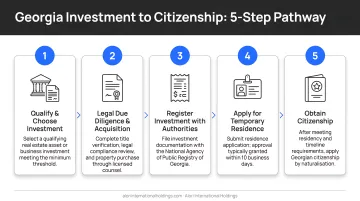
The path from initial investment to Georgian citizenship spans five stages across a minimum of 10 years. Here's what each stage requires.
Step 1: Structure the Investment
Determine which route fits your goals—$150,000 property or $300,000 business/property. Conduct due diligence on the target asset and engage qualified local legal counsel. Document preparation typically takes 2–4 weeks; all documents must be translated into Georgian and notarized.
Step 2: Register the Investment and Apply for Residency
For property investors:
- Complete the purchase and register ownership at the State Services House
- Obtain an accredited appraisal from a GAC-registered body
- Submit the residence permit application to the Public Service Hall or Georgian embassy/consulate abroad
Processing times:
- 30 calendar days: GEL 300
- 20 calendar days: GEL 450
- 10 calendar days: GEL 600
Standard processing is 10–30 business days.
Step 3: Maintain Residency and the Investment
Tier 1 route: Hold the 1-year temporary permit and renew annually for 5 years. The property cannot be sold during this period without risking permit revocation; renting is generally permitted.
Tier 2 route: Hold the 5-year permit. For business investors, maintain minimum annual turnover thresholds; for property investors, retain ownership of the qualifying asset.
Step 4: Transition to Permanent Residency
After 5 years of legal residence (Tier 1), or once you've demonstrated the $300,000 investment was maintained (Tier 2), you can apply for permanent residency. Applicants must pass a Georgian language, history, and law exam at this stage. A medical waiver is available for qualifying conditions.
Step 5: Apply for Citizenship
After 10 total years of legal residence, investors are eligible to apply for citizenship by naturalization.
Processing fees (2026):
- 80 days: GEL 65
- 60 days: GEL 130
- 40 days: GEL 260
- 20 days: GEL 390
Upon approval, the applicant receives a citizenship certificate and ID, and must formally renounce prior citizenship. For US citizens, renunciation carries significant legal and tax implications — review these with qualified legal and financial counsel before committing to this stage.
Georgia's Tax Advantages and Cost of Living
Georgia operates a territorial tax system — meaning foreign-source income is not taxed at all. For American investors earning income outside Georgia, this structure can dramatically reduce the tax drag on global portfolios.
Tax rates:
- Personal income tax: 20% flat rate on Georgian-source income only (territorial system)
- Corporate income tax: 15% standard rate
- VAT: 18% (registration required at GEL 100,000 turnover)
- Property tax: Municipal tax up to 1%
Small business incentives:
- Enterprises with turnover below approximately $11,125 (GEL 30,000) pay 0% corporate tax
- Enterprises below approximately $185,426 (GEL 500,000) pay 1% tax
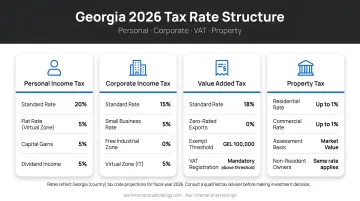
Investors using the $300,000 business route should factor both thresholds into their entity structure from the outset — the tax savings at lower turnover levels are substantial.
The tax picture is only part of the financial case. Day-to-day costs in Georgia reinforce the capital efficiency argument.
Cost of living:
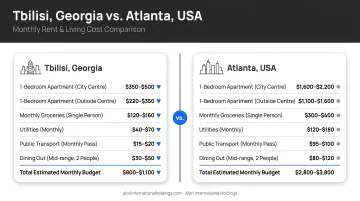
- Monthly cost for a single person in Tbilisi (excluding rent): Approximately $1,353 (GEL 3,649)
- Rent (1-bedroom, city center): Approximately $680/month (GEL 1,834) vs. $1,949 in Atlanta, GA
- Property purchase price (Tbilisi city center): Approximately $6,624 per square meter (GEL 619.19 per sq ft)
The rent comparison alone — $680 vs. $1,949 in Atlanta — represents nearly $15,000 in annual savings. For investors relocating or spending extended time in Georgia, that gap compounds meaningfully against the backdrop of a low-tax environment.
Key Risks and Considerations for American Investors
Dual Citizenship: The Most Critical Decision Point
Most Americans underestimate what it means to renounce U.S. citizenship. Beyond losing the U.S. passport, renunciation triggers potential tax exit obligations under IRC §877A. You're classified as a "covered expatriate" if any of the following apply:
- Net worth exceeds $2 million
- Average annual net income tax liability for the 5 preceding years exceeds $206,000 (2025 threshold)
- Failure to certify tax compliance on Form 8854
Covered expatriates face a mark-to-market tax on worldwide assets, with a 2025 exclusion amount of $890,000. Consult a cross-border tax attorney before pursuing this path.
Schengen Visa-Free Access at Risk
On March 6, 2026, the European Commission suspended visa-free travel for Georgian diplomatic, service, and official passport holders. In December 2025, the EU threatened to revoke access entirely, citing democratic backsliding and visa policy misalignment.
Regular Georgian passport holders still enjoy visa-free access to 137 countries (Arton Mobility Score: 131; Henley Index: 122). That said, this geopolitical pressure is a real risk to the passport's long-term mobility value. For investors focused on portfolio diversification and residency — rather than a second passport — the concern is less immediate but worth monitoring.
Alori tracks regulatory and geopolitical developments across its Georgia portfolio, factoring policy shifts like these into investment recommendations before they affect asset value.
Frequently Asked Questions
What is the golden visa for Georgia?
Georgia's Golden Visa (formalized in 2026) grants temporary or permanent residency to investors who commit $150,000+ (property) or $300,000+ (property or business) to the Georgian economy. Residency terms vary by investment level: 1-year renewable or 5-year initial permits.
How much investment is required for Georgia citizenship?
There is no direct citizenship-by-investment program. Investors need either $150,000 (for a 1-year renewable permit) or $300,000 (for a 5-year permit), followed by 10 years of continuous legal residence before citizenship eligibility. Naturalization also requires passing language, history, and law exams along the way.
How do I become a citizen of Georgia?
Main routes include birth, marriage, and naturalization after 10 years of residence. The investment-linked naturalization path still requires the full 10-year residency period, language/history exams, and formal renunciation of prior citizenship for Americans.
Does buying property in Georgia give you residency?
Yes. Purchasing qualifying property valued at $150,000 or more (as of March 2026, based on accredited appraisal) grants a renewable 1-year temporary residence permit covering the investor and immediate family members. The property must remain registered in your name during the residency period.
Can Americans hold dual citizenship with Georgia?
No. Georgia generally prohibits dual citizenship, meaning Americans who naturalize as Georgian citizens must formally renounce their U.S. citizenship. Unlike Caribbean citizenship programs — which permit dual nationality — Georgia requires a full commitment.