

Introduction
More American investors are exploring EU residency by investment programs as geopolitical uncertainty rises, dollar diversification pressures mount, and the desire for a European "Plan B" intensifies. According to investment migration advisory data from Q1 2025, inquiries from wealthy Americans jumped 183% between Q1 2024 and Q1 2025, with US nationals now accounting for over 30% of all applications processed by major firms.
Yet the decision involves far more than picking the country with the lowest minimum investment. Choose the wrong program, and you risk capital locked in an unstable scheme, missed citizenship timelines, or investments that don't align with personal goals.
The right choice depends on matching your objectives, budget, and lifestyle to the right program. This guide breaks down the key criteria — investment minimums, residency requirements, citizenship pathways, and exit options — so you can evaluate each program against what actually matters to you.
Key Takeaways
- EU residency by investment grants legal residence rights in exchange for qualifying investments like real estate, funds, or government bonds
- Active 2025–2026 programs include Portugal (funds from €500K), Greece (real estate €250K–€800K), Malta (permanent residence from €169K), Hungary (funds from €250K), Cyprus (property from €300K), and Italy (startup from €250K)
- Thresholds and rules shift fast—Portugal ended real estate options in 2023, Spain suspended its Golden Visa in April 2025, Greece raised limits to €800K in prime areas
- Key decision factors: primary goal (residency vs. citizenship), total budget including fees, investment type and risk, physical presence requirements, and citizenship timeline
- Vetted legal structures, accurate local pricing, and clear exit strategies are what separate low-risk transactions from costly mistakes
What Is EU Residency by Investment?
EU residency by investment—commonly called a "Golden Visa"—is a legal pathway through which foreign nationals gain a residence permit in an EU country by making a qualifying financial contribution to that country's economy, without requiring local employment or family ties. For American investors, these programs primarily offer Schengen Area mobility, the flexibility to relocate, and long-term citizenship pathways.
Two program types define the landscape:
Residency by Investment (RBI) grants temporary or permanent residence permits, requiring investors to maintain qualifying investments and meet periodic renewal conditions. Most current EU programs fall into this category.
Citizenship by Investment (CBI) grants immediate passport rights. Following European Commission infringement proceedings against Malta and Cyprus, no EU member state currently offers direct citizenship purely for investment without a genuine residency period and naturalization process.
Investment Pathways Available
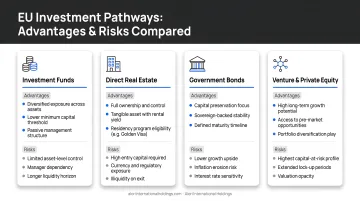
Qualifying investments vary by country but typically fall into four categories:
- Real estate purchases — Property acquisition above program-set minimum values; retains resale potential
- Investment fund units — Capital placed into government-approved funds with defined exit windows
- Government bonds or donations — Fixed state contributions offering lower returns but high security
- Business creation — Startup investments or share purchases requiring active operational involvement
Each pathway carries distinct tradeoffs across capital risk, liquidity, and return potential. The right choice depends on how the investment fits your broader portfolio — not just the visa it unlocks.
| Investment Type | Key Advantage | Key Risk |
|---|---|---|
| Real estate | Rental income + resale value | Transaction costs, market exposure |
| Fund units | Annual yields, defined exit | Manager risk, less control |
| Government bonds/donations | High security, low complexity | Minimal financial return |
| Business creation | Active involvement, upside | Operational and execution risk |
Key Benefits of an EU Residence Permit
The most immediate practical benefit is Schengen Area visa-free travel. As of 2025, the Schengen Area comprises 29 countries following Bulgaria and Romania's full integration. Holders can travel across these countries for up to 90 days in any 180-day period, a meaningful upgrade for American investors who currently navigate visa requirements or entry approvals across much of Europe.
Beyond mobility, EU residence permits deliver longer-term strategic benefits:
- Legal foothold for business operations across EU member states
- Access to quality healthcare and education for family members
- Potential tax advantages depending on the country's resident tax regime (though US citizens remain subject to worldwide taxation)
- Genuine "Plan B" relocation rights if domestic conditions deteriorate
- Pathway to permanent residency and citizenship after a defined number of years, varying by country (5 years in Portugal, 7 in Greece, 10 in Italy)
EU residence permits are extendable and renewable, making them long-term assets rather than short-term visas. From there, the path runs through permanent residency before reaching citizenship—and citizenship is where the picture changes entirely. You gain the right to live, work, and own property in all 27 EU member states, not just the country that issued your permit.
Top EU Residency by Investment Programs: A Quick Overview
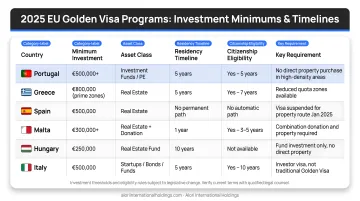
The table below reflects active programs as of 2025–2026. Rules shift frequently — several programs have changed thresholds or closed entirely in the past two years — so treat this as a starting framework, not a final checklist.
| Country | Minimum Investment | Key Routes | Physical Presence | Citizenship Timeline |
|---|---|---|---|---|
| Portugal | €500,000 (funds) / €250,000 (cultural) | Investment funds, cultural projects, research | 7 days/year initially; 14 days per 2-year period | 5 years |
| Greece | €250K–€800K (real estate) | Tiered real estate by region, capital contribution | None | 7 years |
| Hungary | €250,000 (fund) / €1M (donation) | Real estate fund, government donation | None | 8+ years |
| Malta | ~€169,000 total | Mixed contribution/lease/donation | None | N/A (permanent residence only) |
| Cyprus | €300,000 | Real estate, funds, or company shares | Visit once every 2 years | 8 years |
| Italy | €250K (startup) / €500K (company) | Startup investment, company shares, government bonds | Intent to reside required | 10 years |
Critical changes to note:
- Portugal eliminated its direct real estate Golden Visa route via Law 56/2023 in October 2023
- Spain officially terminated its Golden Visa program in April 2025
- Greece raised thresholds in prime regions (Attica, Thessaloniki, Mykonos, Santorini) to €800,000 in 2024
That volatility matters when choosing a program — a route that looks optimal today could close or reprice before your application completes. The next sections break down what to evaluate before committing.
How to Choose the Right EU Residency by Investment Program
Choosing the right program means matching six personal and financial factors to the specific terms of each option. Overlooking even one can result in wasted capital, failed applications, or residency that doesn't serve your actual goal.
Factor 1: Clarify Your Primary Goal
Your objective immediately filters which programs make sense:
- Travel and mobility — Greece (no minimum stay) or Malta (no stay requirement)
- Family relocation rights — Programs with family inclusion and quality healthcare/education access
- Path to EU citizenship — Portugal (5 years), Greece (7 years), or Italy (10 years)
- Investment returns — Fund-based routes with defined yields and exit windows
A Portugal fund investment suits someone focused on citizenship within 5 years and potential fund returns. Malta's Permanent Residence Programme suits someone who wants lifetime permanent residence without a citizenship objective.
US tax implications: Americans must consider FBAR reporting requirements (FinCEN Form 114) if aggregate foreign financial accounts exceed $10,000, and FATCA obligations (Form 8938) for specified foreign financial assets exceeding $50,000 for unmarried individuals living in the US. Consult a cross-border tax advisor before selecting a program—this is a step most country comparison guides omit.
Factor 2: Investment Budget and Total Cost
The "minimum investment" headline figure is never the total cost. Research government fees, administrative processing charges, legal and advisory fees, health insurance, and ongoing renewal costs.
Portugal (€500K fund route) total costs:
- Fund investment: €500,000
- AIMA application fee: €632.10
- Residence permit issuance: €6,314.20
- Renewals: €3,157.80 every two years
- Legal and advisory fees: €5,000–€15,000 estimated
Greece (€250K real estate route) total costs:
- Property purchase: €250,000 minimum (€800K in prime areas)
- Property transfer tax: 3.09%
- Notary fees: 1–1.6%
- Land Registry fees: 0.5–1%
- Legal and transaction costs: €5,000–€10,000
Malta (MPRP rental route) total costs:
- Administration fee: €60,000
- Government contribution: €37,000
- NGO donation: €2,000
- Five-year rent commitment: €50,000 (€10K/year minimum)
- Total: ~€149,000–€169,000 before legal fees
Compare total acquisition costs across two to three shortlisted programs. A key distinction: fund units can typically be sold after the holding period, while government contributions and donations are non-refundable.
Factor 3: Investment Type and Risk Profile
Each investment vehicle carries a different risk, liquidity, and return profile.
Fund-based investments (Portugal, Hungary):
- Potential annual yields and defined exit windows
- Subject to PFIC (Passive Foreign Investment Company) rules for US taxpayers, requiring Form 8621 and proactive tax elections to avoid punitive default rates
- Lower direct control over underlying assets
Direct real estate purchases (Greece, Cyprus):
- Market valuation risk and transaction costs
- Potential rental income (6–10% yields in coastal Portuguese markets)
- Directly held foreign real estate is NOT reportable on FBAR or FATCA Form 8938
- Holding through foreign entities (corporations, partnerships) negates this exemption and triggers complex IRS reporting (Forms 5471 or 8865)
Government bonds or donations (Malta, Hungary):
- Lower returns but high security
- Sunk costs with no capital recovery
Cross-border real estate purchases carry legal and transaction risks that directly affect both investment returns and visa outcomes. Alori International Holdings focuses specifically on this gap—sourcing vetted Portuguese projects with verified ownership structures, disciplined entry pricing, and defined exit strategies built in from the start.
Factor 4: Physical Presence Requirements
Presence requirements vary enormously and matter greatly for Americans who are not planning full relocation:
- Portugal: 7 days in year 1; 14 days per subsequent 2-year period
- Greece: No minimum stay requirement
- Hungary: No stay requirement
- Cyprus: Visit once every 2 years
- Malta: No minimum stay
- Italy: Intent to reside required, though no explicit minimum
Failing to meet presence requirements—even inadvertently—can jeopardize permit renewal and citizenship timelines. Be honest about how much time you realistically expect to spend in Europe.
Factor 5: Timeline to Citizenship (If Relevant)
For investors with a long-term goal of EU citizenship and passport access, the timeline from initial residence permit to eligible citizenship application varies significantly:
- Portugal: 5 years
- Greece: 7 years
- Cyprus: 8 years (12 months continuous + 7 years cumulative)
- Hungary: 8+ years
- Italy: 10 years
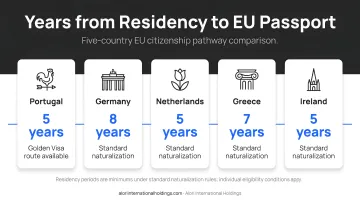
These timelines start from initial application, not approval date. Citizenship unlocks rights in all 27 EU member states, not just the issuing country—a materially different asset than residency alone. For US investors who already hold a strong passport, EU citizenship primarily adds Schengen Area freedom without annual renewal requirements.
Factor 6: Program Stability and Regulatory Risk
EU residency programs operate under national law and are subject to change without notice. Recent examples:
- Portugal: Eliminated real estate as a qualifying investment in October 2023 via Law 56/2023
- Spain: Suspended its Golden Visa in April 2025 via Organic Law 1/2025
- Greece: Raised prime real estate thresholds to €800,000 in 2024
The European Commission continues to scrutinize passive investor residency programs for compliance risks. Investors who entered discontinued or altered programs were either grandfathered in or forced to pivot, depending on timing.
Evaluate a program not just on current terms but on its regulatory track record, EU-level scrutiny, and whether the host government has signaled upcoming changes. Act during periods of program stability rather than waiting until a program closes or raises thresholds further.
How Alori International Holdings Can Help
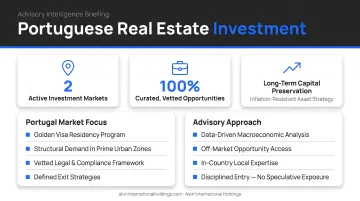
Alori International Holdings takes a selective approach to international real estate investment—focused on high-conviction markets including Portugal, where macroeconomic analysis, local expertise, and in-market professional networks combine to identify opportunities built for long-term capital growth.
For investors pursuing EU residency through real estate or fund-linked investments in Portugal, Alori's model addresses two of the most common risk points in cross-border investment:
- Legal and transaction risk: Vetted legal structures, verified ownership, and coordination with local professionals who understand Portuguese regulations and transaction processes
- Pricing risk: Accurate local market intelligence that prevents overpaying in an opaque market, backed by access to off-market opportunities through developer relationships and priority access to select developments before public launch
Key differentiators for investors evaluating EU residency by investment:
- Access to off-market opportunities through established developer relationships and local networks
- Disciplined entry points that avoid speculative or momentum-driven pricing
- Clear exit and rental strategies built into each opportunity, with realistic 5-year growth outlooks grounded in market data
- Long-term capital mindset aligned with the multi-year nature of EU residency programs
- Selective deal access focused on quality over volume — Alori operates as a trusted gateway, not a public listing platform
These differentiators matter most when the path to residency itself is layered. Portugal's Golden Visa no longer accepts direct real estate as a qualifying route, so many investors pursue a dual-track approach: using the €500,000 fund investment route for residency eligibility while separately investing in direct real estate for rental income and capital appreciation.
Conclusion
Choosing an EU residency by investment program is a high-stakes, multi-variable decision. The best program is not the most popular or the cheapest — it's the one that fits your specific goals, budget, risk tolerance, presence requirements, and citizenship timeline.
Programs evolve and conditions change. Treat your residency strategy as a living asset, not a one-time administrative task. Review it as your goals shift and as program rules update. That means the right advisor relationship matters as much as the right program.
When evaluating your options, return to these core variables:
- Goals and timeline: Residency for lifestyle, tax planning, or eventual citizenship each point to different programs
- Investment structure: Real estate, funds, and donation routes carry different risk and liquidity profiles
- Presence requirements: Some programs demand physical stays; others are largely hands-off
- Exit flexibility: How and when you can recover capital should factor into the decision from day one
For American investors combining Portuguese market opportunities with residency planning, the right advisory partner brings together legal due diligence, accurate pricing intelligence, and defined exit strategies — reducing the transaction risk that cross-border investments carry by default.
Frequently Asked Questions
Does buying property in Europe give you residency?
No. Purchasing real estate in Europe does not automatically grant residency—it must be done through a country's specific Golden Visa program at the qualifying investment threshold. Some programs (like Portugal's) no longer allow direct real estate as a qualifying route, while others (Greece, Cyprus) still do.
Which countries allow residency by investment?
Main active EU programs include Portugal (funds and donations from €500K), Greece (real estate €250K–€800K depending on region), Hungary (investment funds from €250K), Malta (permanent residence from ~€169K total), Cyprus (real estate and shares from €300K), and Italy (startup or bond investment from €250K). The list changes as programs open, close, or modify terms.
Which is the easiest country to get permanent residency in Europe with investment?
Malta's Permanent Residence Programme is among the lowest-cost routes, offering lifetime permanent residence from approximately €169,000 total. Cyprus grants permanent residence within roughly 9 months starting at €300,000. The right choice depends on whether cost, speed, or minimal presence requirements matter most to you.
Which EU countries offer citizenship by investment?
No EU member state currently offers direct citizenship purely in exchange for investment. Following European Commission infringement proceedings against Cyprus and Malta, all EU countries now offer residency by investment, after which investors can pursue naturalization after meeting citizenship residency requirements—typically between 5 and 10 years.
What is the easiest European country for a US citizen to move to?
Portugal and Greece are the most accessible EU residency options for Americans. Portugal requires just 7 days per year on-site, has strong English-language infrastructure, and offers a 5-year citizenship path. Greece requires no minimum stay, starts at €250,000, and typically processes applications in around 4 months.
What is the golden visa for 500,000 euro?
Several EU programs sit at this threshold: Portugal's fund route (post-2023 real estate rule changes), Italy's share purchase option, and Greece's capital contribution route all start at €500,000. The residency rights and citizenship timeline vary by country, so the qualifying investment is only one part of the decision.