

Introduction
Georgia sits at a crossroads few Americans have on their radar. While digital nomad hubs like Portugal and Thailand saturate expat forums, this small Caucasus nation operates one of the world's most permissive visa regimes: citizens of over 90 countries can stay 365 days without a permit, work remotely legally, and access European-style infrastructure at a fraction of Western costs. Yet most Americans couldn't place Tbilisi on a map.
The gap between Georgia's accessibility and its visibility creates real opportunity. The tax structure rivals the UAE for entrepreneur-friendliness, foreigners can buy property with fewer restrictions than in most of Europe, and a single person can live comfortably in Tbilisi for under $1,200 a month.
That picture has limits, though. Romantic notions dissolve fast when confronting Georgian bureaucracy, a language barrier with no Latin script, and infrastructure that gets uneven quickly outside major cities.
This guide covers the practical realities — no romanticized expat fantasy. Specifically:
- Visa rules that work until they don't
- Neighborhoods where expats actually live
- What $150,000 buys in Tbilisi versus Batumi
- Tax advantages for remote workers and small business owners
- What the bureaucracy and daily friction actually look like
Key Takeaways
- US citizens stay visa-free for 365 days with legal remote work allowed
- Comfortable living costs $1,200–$1,500/month in Tbilisi, significantly less in smaller cities
- Self-employed individuals pay 1–3% tax on turnover; 0% corporate tax on undistributed profits
- Foreigners buy residential property freely; $150,000+ investment qualifies for residency
- English is enough in Tbilisi's expat districts, but Georgian or Russian helps outside them
Visa and Residency: What Americans Need to Know
Visa-Free Entry and the 365-Day Policy
US citizens enter Georgia and remain for a full year without a visa or residence permit under Ordinance No. 255 from Georgia's Ministry of Foreign Affairs. This applies to 90+ nationalities and covers remote work performed for foreign employers or clients—making Georgia one of the few countries where "working on a tourist visa" is explicitly legal.
The "Remotely from Georgia" program launched in 2020 has been phased out, effectively superseded by the standard visa-free regime. That program required $2,000 monthly income or $24,000 in savings; the current 365-day entry carries no income threshold.
2026 work permit requirement: New amendments to Georgia's Law on Labour Migration effective March 1, 2026 require foreign nationals to obtain a formal work activity permit for employment, self-employment, or entrepreneurial activity. This leaves remote workers on visa-free entry in a gray area—enforcement patterns remain unclear. Consulting an English-speaking Georgian immigration lawyer before arrival is strongly advised.
Residence Permits and Long-Term Options
Staying beyond one year requires a temporary residence permit. Three common pathways:
- Employment/Business Registration: Registering a Georgian company or securing employment with a local entity
- Property Investment: Purchasing real estate valued at $150,000+ (based on certified appraisal, increased from the historical $100,000 threshold)
- Investment Residence Permit: Making a $300,000+ investment (real estate or other qualifying assets)
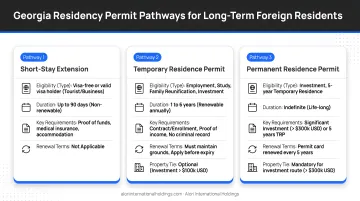
The property route offers the fastest track for Americans with capital. Transactions close quickly in Georgia, and ownership directly qualifies you for residency without additional income requirements.
Watch the 183-day threshold: Anyone spending 183+ days in Georgia within a rolling 12-month period automatically becomes a Georgian tax resident and must file accordingly. This catches Americans who arrive on the visa-free regime and cross the threshold without tracking it. Georgia taxes worldwide income for residents, though territorial exemptions apply to foreign-sourced income in many cases. Sorting out tax and residency status before that mark—ideally with a local English-speaking tax professional—prevents costly compliance errors. For Americans pursuing the property investment route, understanding these timelines before closing is especially important.
Best Cities and Neighborhoods for Expats in Georgia
Tbilisi: The Expat Capital
Tbilisi absorbs the majority of Georgia's expat population for practical reasons: it's the only city where Western amenities, international schools, co-working spaces, quality private healthcare, and English-speaking professionals exist reliably.
The city blends Ottoman-era architecture with Soviet-era blocks and a thriving startup café culture. Expats cluster in specific neighborhoods:
- Vake: Upscale, clean air, walkable, excellent schools and restaurants
- Saburtalo: More affordable, good metro access, university area with younger energy
- Marjanishvili: Up-and-coming, lower rents, grittier but improving rapidly
- Old Town: Tourist-oriented, charming cobblestones, higher short-term rental costs
For families, Tbilisi has two established international schools: QSI International School (Middle States accredited since 1999) and British International School of Tbilisi (COBIS Patron's Accredited, offering IGCSE and A-Levels). Private healthcare through clinics like Mega Medical and Aversi is the standard; public facilities lag Western benchmarks significantly.
Traffic congestion and air pollution are real downsides, particularly in winter when thermal inversions trap emissions in the valley.
Batumi: Coastal Living on the Black Sea
Batumi offers a coastal alternative with a completely different rhythm. Summers bring beaches, nightlife, and heavy tourism; winters turn the city quiet and rainy. Batumi averages 2,435mm annual precipitation, making it the wettest city in the Caucasus region.
Rent fluctuates dramatically with season. A one-bedroom apartment renting for $500/month in winter can jump to $2,500+ during peak summer months. The city works best for those comfortable with seasonal income variability or retirees seeking slower-paced coastal living.
English speakers find Batumi more accessible than rural Georgia but less international than Tbilisi. The city's casino and resort infrastructure attracts Russian and Turkish tourists, influencing the local service economy and language mix.
Kutaisi and Beyond
Kutaisi, Georgia's second city, offers the most budget-friendly option with authentic Georgian character and good low-cost European flight connections. Rent runs 40-50% below Tbilisi rates, and the slower pace appeals to those avoiding capital city intensity.
Outside major cities, the practical realities shift considerably:
- Language: English disappears almost entirely; Russian is more widely understood among older Georgians
- Notable towns: Sighnaghi (wine country charm) and Gori (Stalin's birthplace) reward visitors but demand basic Georgian or Russian for daily life
- Infrastructure: Patchy roads, slower internet, and limited services are the norm rather than the exception
Cost of Living in Georgia
Rent and Accommodation
Central Tbilisi one-bedroom apartments range $400–$800/month for long-term rentals. Short-term Airbnb rates run higher. Batumi shows similar baseline pricing but with steep seasonal swings driven by summer tourism demand. Kutaisi and rural areas drop to $200–$400/month.
Property prices have risen faster than rents in recent years. Geostat's Residential Property Price Index showed 3.3% year-over-year growth in Tbilisi for Q4 2025, making long-term rental more cost-effective for shorter stays. For those planning multi-year residence, property purchase is increasingly compelling.
Finding housing:
- MyHome.ge and SS.ge (both have English versions) dominate listings
- Fake listings exist; verify properties before transferring deposits
- Estate agents work differently than in the US—owners pay agent fees, exclusivity doesn't exist, viewings often happen with the owner present
- Negotiate directly; published prices often have 10–15% flexibility
Daily Expenses and Budgeting
Realistic monthly budgets:
- Single expat: $800–$1,000/month excluding rent, or $1,200–$1,500 all-in
- Couple: $1,500/month total including rent
Daily costs in Tbilisi (Numbeo April 2026):
- Inexpensive restaurant meal: 30 GEL ($11)
- Milk (1L): 5.39 GEL ($2)
- Eggs (12): 7.16 GEL ($2.65)
- One-month unlimited public transport pass: 40 GEL ($15)
- Basic utilities (915 sq ft apartment): 226 GEL ($84) monthly
Internet is well-developed in cities. Ookla Speedtest data shows Tbilisi fixed broadband median at 45.52 Mbps, with fiber widely available. Mobile SIM cards are cheap; major carriers include Magti, Beeline, and Silknet. Bolt and Yandex (similar to Uber) provide app-based taxis at low rates.
Heating costs spike in winter if your accommodation has poor insulation—confirm heating systems and insulation quality before signing leases.
Tax Advantages Worth Knowing
Georgia's tax structure makes it attractive for entrepreneurs and remote workers:
- Small Business Status: Self-employed individuals pay 1% tax on gross income up to 500,000 GEL annually; exceeding this triggers 3%
- Corporate Income Tax: 0% on undistributed profits under Estonia-style model; distributed dividends taxed at 15%
- Personal Income Tax: Flat 20% rate applies only to Georgian-sourced income
- Territorial taxation: Foreign-sourced income received by residents is generally not subject to Georgian income tax under the territorial system
- No traditional social security tax
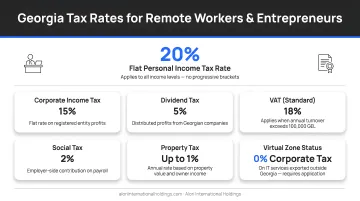
These rates apply once you establish Georgian tax residency (183+ days).
Georgia's favorable tax rules don't eliminate US obligations, however. American citizens must still comply with worldwide income reporting regardless of residency:
- FATCA reporting requirements apply wherever you live
- The 2026 Foreign Earned Income Exclusion allows excluding up to $132,900 of foreign earned income
- File FBAR (FinCEN 114) if foreign account balances exceed $10,000
Daily Life: Culture, Food, Language, and Community
Georgia's rhythm centers on family, hospitality, and food. The supra (traditional feast) remains central to social life—multi-hour meals with elaborate toasts, endless wine, and dishes like khachapuri (cheese bread) and khinkali (soup dumplings). Mealtimes are social events that stretch for hours.
Georgia is documented as the birthplace of wine, with biomolecular evidence dating grape wine to 6,000–5,800 BC. The Qvevri clay vessel wine-making method is inscribed on UNESCO's Intangible Cultural Heritage list. Wine culture is not recreational—it's identity.
That cultural depth extends to the language. Georgian belongs to the Kartvelian family, uses its own 33-character script (Mkhedruli), and takes serious effort to learn. Georgia scores 541 (Moderate proficiency) on the EF English Proficiency Index 2025, with Tbilisi slightly higher at 550.
English works in urban centers among younger Georgians; Russian remains more widely understood outside cities and among older populations.
Learning basic Georgian phrases earns genuine respect and materially improves daily interactions. Expats who stay long-term almost universally recommend investing in language learning early.
Building Your Network
Tbilisi's expat community is growing and relatively close-knit. Key entry points include:
- Facebook expat groups (active and well-organized)
- Co-working spaces like Terminal and Impact Hub
- Expat-oriented events in Tbilisi's city center
Making friends is easier in Batumi but harder without Georgian or Russian. For healthcare, private clinics meeting international standards are recommended over public facilities for anything beyond routine care.
Buying Property in Georgia as a Foreigner
Foreigners can legally purchase residential and commercial property in Georgia with the same ownership rights as citizens. No restrictions, no stamp duties, and a fast transaction process that often closes within weeks.
The key exception: Agricultural land cannot be purchased by foreigners under the Organic Law on Agricultural Land Ownership. Some land on city outskirts remains zoned agricultural; rezoning processes are complex and opaque. Verify zoning status before committing.
The investment case: Property prices in Tbilisi rose 3.3% year-over-year in Q4 2025, with Batumi primary market reaching $1,821/sqm in Q3 2025. Georgia recorded 7.07 million international visits in 2023, a 30% annual increase driving strong short-term rental demand. Property purchase serves dual purposes: lifestyle decision and capital diversification.

The $150,000 investment threshold (increased from $100,000) qualifies buyers for residence permits, making property investment a pathway to legal long-term status without employment or business registration.
Transaction complexity: Navigating Georgian property deals requires verifying legal title, understanding local zoning, structuring purchase agreements, and planning exit strategies. Firms like Alori International Holdings work with American investors specifically on Georgian acquisitions, covering legal due diligence, verified project selection, and exit planning from the outset.
Pros, Cons, and What No One Tells You
What Georgia Gets Right
Few countries offer this combination of access, affordability, and upside for foreign residents and investors:
- Extraordinary visa flexibility (365 days, no questions asked)
- One of Europe's lowest costs of living
- Genuinely welcoming culture rooted in deep hospitality traditions
- Dramatic landscapes — Caucasus mountains, Black Sea coast, ancient wine regions
- Strong and growing expat infrastructure in Tbilisi
- Highly favorable tax environment (1–3% for small businesses, 0% on undistributed profits)
- Simple property purchase process with full foreign ownership rights
The Cons Worth Knowing
The advantages are real, but Georgia asks for trade-offs that catch many newcomers off-guard:
- Language barrier is significant and largely unavoidable outside major cities
- Bureaucracy is inconsistent — different offices routinely give conflicting information
- Public healthcare falls well below Western standards (private insurance is essential)
- Infrastructure outside Tbilisi is rough: patchy roads, slower internet, limited services
- Import taxes on personal goods are higher than most expect (rates on electronics and clothing can exceed 18%)
- Local job salaries are very low ($300–$600/month is typical) — Georgia works best with remote income or existing capital
Before You Go: A Short Checklist
A little preparation upfront prevents the most common headaches:
- Understand US tax obligations before crossing the 183-day residency threshold
- Arrange private health insurance — local or international coverage both work
- Set up a local bank account early — TBC Bank and Bank of Georgia both allow foreigners to open accounts with just a passport
- Get local legal help for anything involving residency or property
- Confirm your accommodation has proper heating and insulation before winter arrives
Frequently Asked Questions
Where do expats live in Georgia?
Most expats settle in Tbilisi, particularly in Vake, Saburtalo, and Marjanishvili neighborhoods, which offer English-speaking communities, reliable infrastructure, and easy access to cafes and coworking spaces. Batumi is the secondary choice for those preferring coastal living with seasonal rhythms.
How much money do expats need to live comfortably in Georgia?
A single expat can live comfortably in Tbilisi on $800–$1,000/month excluding rent, or $1,200–$1,500/month all-in. A couple typically spends around $1,500/month total, which puts Georgia among the lowest-cost options in the region for remote workers and retirees alike.
What is the safest place in Georgia to live?
Georgia has low violent crime rates and is considered safe for everyday living. Tbilisi's Vake and Saburtalo neighborhoods are consistently cited as the safest and most expat-friendly residential areas. Batumi is also regarded as safe for everyday living.
Can Americans buy property in Georgia?
Yes, Americans can freely purchase residential property in Georgia with no foreign ownership restrictions, no stamp duties, and a clean transaction process. Agricultural land is the main exception and cannot be purchased by foreigners.
Do I need a visa to move to Georgia as an American?
US citizens do not need a visa for stays up to 365 days. For stays beyond one year, a temporary residence permit is required, obtainable through employment, business registration, or property investment of $150,000+.
What are the tax benefits of moving to Georgia?
Georgia offers very low tax rates: 1–3% on turnover for self-employed individuals, 0% tax on undistributed corporate profits, and income tax only on Georgian-sourced income. Americans remain subject to US tax obligations no matter where they live.